Sunday, March 20, 2022

Swamp Time

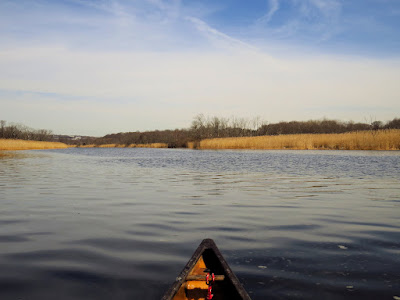
The water was high when I put in.  The Mattabesset drains into the Connecticut River and when the big river is running high, this on just backs up like a reservoir.  Unlike most rivers, when the Mattabesset is high, it has almost no current.  The river is just barely out of the banks, not so much that I could paddle through the forest like I did last summer, but it does open up many short cuts and side areas. 

The weather overcast with heavy blue-gray clouds and temperatures near 60.  There is a light wind.

Heading down river, I notice that there are quite a few new beaver cuts and peels just a quarter mile in.  This is sign of a new colony although I cannot locate the lodge.  Otherwise, it is a very quiet day, wildlife-wise.  Most of the waterfowl will be away from the open water of the river channel - there is plenty of water to feed in back in the extensive marsh on either side.

The new Tepee Lodge is somewhat flooded and I cannot say if there is enough room inside for the colony or not.At least it is still well maintained.  The original Tepee Lodge is down to a round pile of sticks.  The abandoned eagle nest, which hasn't been used for 2 or 3 years, is completely gone - either the tree fell or, more likely, the nest was blown out.  Either way, it is gone and I can't figure out where it used to be.

One of the Coginchaug Lodges

The Coginchaug beaver lodges are looking great.  There are two close built right on the main channel and they are both taller and larger than the lodges I passed on the Mattabesset.

I tried again to get back into an old quarry pond that another canoeist tipped me off to.  I get a little farther, but the shallow creek is badly blocked by large downed trees.

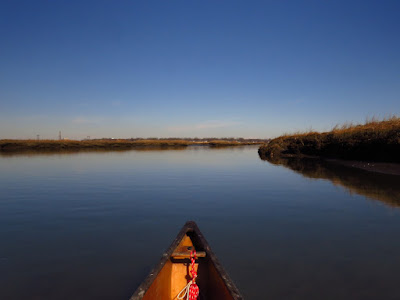
I continue up the Coginchaug to the usual turn back point, where the river runs fast and shallow through an somewhat open area of blow downs.   

When I get back to the first patch of beaver cuts and peels, I spot a good sized beaver up on the back doing a little bit of eating and a lot of basking.  I'd guess it is a 25-30 pounder. It is unperturbed by my arrival, so I watch it for a few minutes before continuing.

Friday, March 18, 2022

Lord Cove

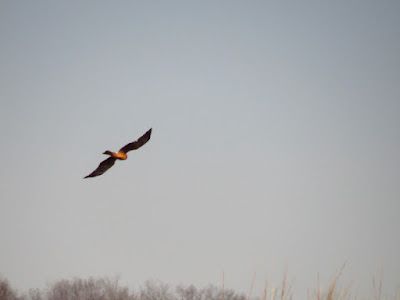
 Calm air and high water took me out into the main river from where I could enter Goose Bay by the "other" entrance.  Just as I thought it might be a no-motorboat day, a fast work boat comes down the river. But, it turns back before getting to me.  It looks like it might be spring run-up time for the local fire department boats.  As I turn in to the channel leading to the bay, there's a high pitched screech, and a Harrier takes off.  Just when the Harrier thought it might be a no-canoe day...  Up in the next bend are two Ducks.  The Harrier flies over and they flee.  Just when the Ducks were starting to think it might be a no-Harrier day...  

The "other" way in to Goose Bay
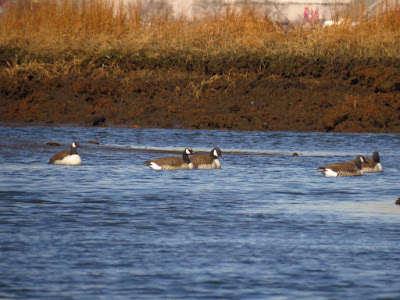
I was going to round the bay following the shore, but there are about 75 Canada Geese ahead.  Just as they start that nervous honking that they do before flying off, I turn away.  There's no need to pester them.  I cross the bay straight through the center, something that can only be done when the tide is halfway up or more as most of Goose Bay is one step away from becoming a meadow.
Green Winged Teal

The route follows the outer channels of the the cove, clockwise although it is a very elongated clock.  The bird life is a spring mix - some Black Ducks, some Common Mergansers, a few Buffleheads, and a few Widgeons, and a few Green-Winged Teal.

I head all the way into the farthest reach of the Eagle Cove.  One of the Bald Eagles is on the nest tending eggs.  This pair are the most productive Eagles that I've ever seen, fledging three young in each of the three years that I've observed them. 

Bald Eagle nest

From there, I start back out, heading into the Bridge Cove as far as possible.  The high water lets me scoot over a boulder shelf that normally blocks access to the last few hundred yards.  With that completed, I continue out following closely the east shore.


Tuesday, March 15, 2022

Spring Time, Definitely

 It's a good day for a longer paddle.  I set out from under the bridge sometime around high tide, with a very light wind, and temperatures climbing well into the 50's.  I cross the river and head up through the four island complex - Pope's Flat, Long, Peacock and Carsten Islands.  I flush fifteen Black Ducks in the channel between Peacock and Carsten.  They head up to the top of the marshy islands and circle looking for a new spot to set down.  I flush them one more time, but they're not much interested in flying too far.

I follow the east shore up to the dragonfly factory.  They're flight testing a private helicopter - first time I've seen anything that wasn't a military variant.  It's unusually noisy, as if something isn't lined up quite right with the rotors.  It's nice when it finally stops hovering and flies off.

I circle Dragonfly Island.  That's not the name on the maps, but I always have a hard time remembering place names which have no connection to the place where they are at.  From now on, it is, Dragonfly Island.  And, the island downstream is, Peck's Island, as far as I'm concerned.  Peck's Mill was once on the east bank although there is no sign of it anymore.  But, I don't have trouble remembering historic details, so Peck's Island it is.  After circling Dragonfly Island I head back downriver along the west bank.  

Near the entrance to Garbage Cove, I spot seven Wild Turkeys in the brush on top of a small knoll.  

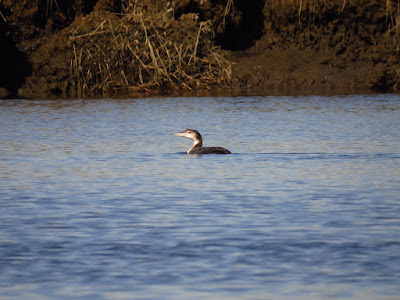
At Pope's Flat (flat is an old term attached to some of the low marsh islands in these parts) I spot a Loon, which dives and swims submerged far enough that I don't spot it again.  A Swan comes over and does the power-pump.  It is an aggressive warning that signals that Swan hormones are starting to rage.  It is a bit intimidating - the Swan raises its wings over its back to make it look larger, then it tucks the head and swims with strong pumping foot motion that pushes a minor wall of water in forwards.

Friday, March 11, 2022

Spring Time, Almost

It is a fine day with near calm air, sun and temperatures climbing into the mid 40's.  I set out from under the bridge on a tide that won't matter - today's tide coefficient is very low, which means that the difference between high and low tide, and the resulting currents, are small.

Everything is in place except for my camera, which I forgot at home.  I paddle down river and then through Nell's channel.  The marsh seems to have a good number of Ducks and Geese, as it did on the last trip, although the water is too low for me to scan across the marsh - eye level is just below the top of the bank.

Back in the river, I start spotting quite a few Common Loons...more than I usually see.  There are also quite a few Swans.  

I head down to the lowest navigation pillar - a twenty foot tall stone and cement marker from past days.  There are three oyster boats working the area.  Two Loons, which are usually skittish around people, are hanging close to one of the boats.  They rush in every time the crew starts sorting, picking off anything edible that goes over the side.  By this time, I've seen about a dozen Loons, three of four times what I usually count.

I follow the east side of the river back up, spot one mature Bald Eagle and one male Long Tail Duck... wish I had the camera for that beautiful Duck.

Saturday, March 5, 2022

Long Views

 It might, so far, be the best day of the year. It's hard to say though as there haven't been many good days for canoeing.  I put in with the tide still rising, the sky mostly clear with some high thin clouds, almost no wind, and temperatures in the 40's.

Just downriver of the first bridge are three Common Loons.  The checked pattern on their backs is returning.  Those patterns fade out during winter.

Common Loons - note the back pattern returning after winter

The tall spartina of the marsh was knocked down by winter snows, so with the high water, I have expansive views across the marsh.  And, for a change, I can see the layout of the smaller channels that weave and often dead end in the marsh.  There are a great number of Canada Geese.  They are up out of the water in flocks of 15 to 50.  I can only imagine that they are sunning in the pleasant conditions, not to different than myself.  I start with an estimate of 300 Geese, but as I cut down through the center of the marsh, I keep adding to that number.  I end with a guess of a 500 Geese.  My last trip through the marsh was during Goose hunting season, I spotted one Goose hunter and zero Geese.  Funny how that works.

I get to the bottom of the marsh and head to the east.  I spot a Harrier, the white butt patch obvious, plus the fact that it was flying low like a Harrier.  Looking for a perch, it finally settled on the bank where I got a couple photos.  When I aimed my camera again, I saw the Harrier walking off into the brush.  But no, that turned out to be a red fox and the Harrier had retreated to tree perch.  I paddled on and the Harrier took the lead, taking one quick swipe at a pair of snoozing Black Ducks, but the Ducks escaped.  

Harrier, just before the fox enters the scene

I returned back through the center of the marsh.  The Loons were still fishing just downstream of the bridge.

Friday, February 11, 2022

Beat the Tide

I catch the middle of the falling tide and ride a strong current down to the marsh.  But, I paddle steady the whole time as I figure that I can just barely make it around the inside of the marsh before the water gets too low...and I get stuck.

It is the finest day of the year, with almost no wind, clear sky, and temperatures in the mid 40's.

There are very few birds about, just some Mallards and Red Breasted Mergansers, so the paddling is uninterrupted.  Even in the marsh, it is surprisingly quiet.  

Common Loon
The "height of land", so to speak, is the area north of the the Audubon Center.  More or less, this is where the tide waters meet or diverge.  It is just a few inches deep when I get there, so there is no time to lose.  I try to read the water, looking for a bit of current - that's where the deepest water will be.  I get through with just a bit of poling with my "rock" paddle.

Harrier
I head out into the river mouth, but there are still few birds other than Gulls and three Mute Swans.  I head back through Nell's channel.  I spot one Coot, three Buffleheads and a Common Loon, and then a Harrier that has taken off from Nell's Island. Farther up the channel I spot of flock of Geese.  They don't move as I approach...apparently, it is Goose hunting season.  Lousy day for Goose hunting in the marsh as I have not seen one during the entire paddle. 

Decoys

I spot one more Loon as I head back up the river on a slack current.

Wednesday, February 9, 2022

Winter Factors

The winter factors - wind, temperature, and ice.  Most of the new year has been less than good enough for canoeing.  Many days were almost good, with only one of the factors out of step - sunny days with 20mph wind, calmer days with temperatures in the teens, and the dreaded 35 degree rain days.  I prefer being outside on a nice 20 below zero day to being out in 35 degrees and rain.  

Finally, sun and light wind with reasonably warm air.  I put in under the big highway and headed down to the marsh.  I know the water will be open, unlike many of my other favorite spots which will still be iced up for a few more days.  The only shortcoming is that the tide is low and I won't be able to circle the big marsh.

We had a snowstorm about a week ago.  It only dumped a foot of snow here, but it came with 24 hours of 30mph wind.  The spartina grass in the marsh has finally been knocked down.

Red Shouldered Hawk...maybe
When I reach the top of the marsh I head up Beaver Creek hoping for half of the bird action that I saw on my last trip.  I almost miss it - paddling in and looking ahead, and there is a Red Shouldered Hawk sitting and watching me pass from a piling not fifteen feet away.  As I hit the meanders, I start spooking Black Ducks and Mallards, the usual mix that I expect in here.  Then, a couple Hooded Mergansers, then a Hawk swoops in and makes a try for the hen Merganser.  She dives and the Hawk immediately retreats to a tree perch a hundred yards off.  The hen plays it safe, swimming low - thinking small, and near the shore so that a second attack will have to come from a predictable direction.  But, the Hawk has given up for the moment.  I can't identify this second hawk even though I got a pretty good look at it.  It might be a dark morph of Broad Shouldered Hawk...but that level of birding is out of my range.

A couple more meanders and the low tide runs me out of water.  As I turn I spot a Sharp Shin Hawk streaking through the nearby trees.  I pass the Red Shouldered once again on the way out.  Unusually, it is just not perturbed by my presence.

I head up and just a bit past Cat Island where I run out of tide, as I expected.  A good enough trip I start back.  As I leave the marsh I find a mature Bald Eagle in a high tree perch and a Common Loon working the current near the lowest bridge.