Saturday, April 27, 2013

What You Do With the Good Ones

I set out at low tide, at the very turn of the tide, the boulder groins exposed as much as they ever are, black with the saturation of seawater and green with a thin layer of plant life.  An osprey hovers to the south and three cormorants sun themselves on low rocks to the north.  I paddle up the coast with a mild cool offshore breeze on one side and the heating of brilliant morning sun on the other.

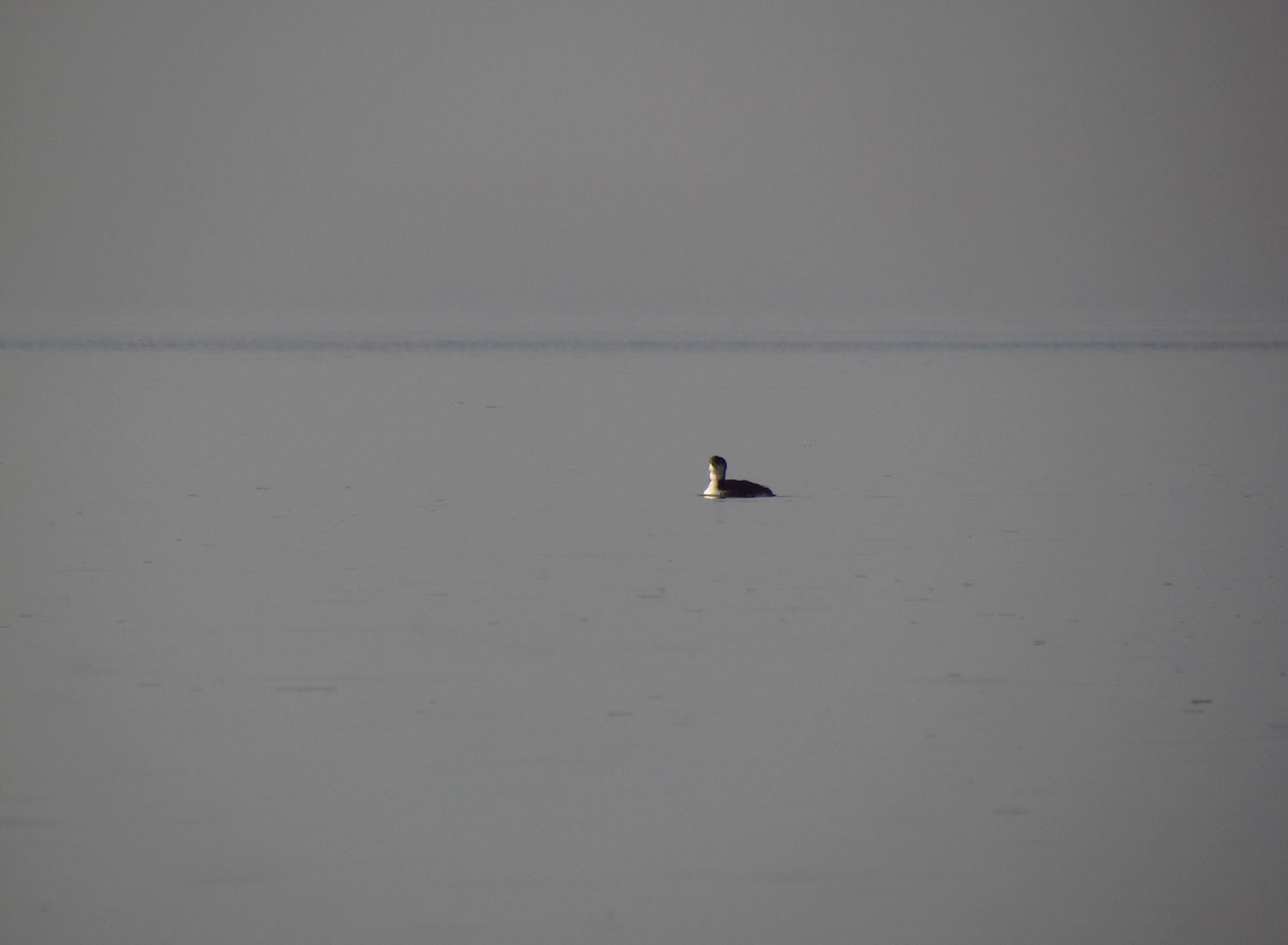
Since my last trip, which was too long ago, due to my rebuilding of my studio and some fairly windy spring days, the bird life has changed.  The brants are gone, as are the long-tailed ducks, and the red breasted mergansers that fished here so often are nowhere to be seen.  Life is always richest at the edges - whether one is referring to nature or one's own life. The edge that is winter is fading away and the comparative mediocrity that is summer approaches.  In the first bay, I spot a black and white floating at a distance too far for even my camera.  I turn toward it and, after paddling about fifty yards, it dives.  I wait.  And I wait.  I wait a very long time, scanning to my left and right.  It comes up well to my left, a common loon - with an underwater swim that approaches 200 yards.  I find a few great egrets in the rocks at Merwin Point, and several cormorants, arriving for summer, have set up on the islets.  And then, my thoughts drift elsewhere.


A friend died this week.  N was an elder in the wisest sense, her husband a teacher, and her children were and still are my friends.  I spent quite some time at their house during my teens and early twenties.  It was a place where youth could explore the intellectual edges.  The sometimes good and sometimes idiotic ideas of teenagers were heard and, if they deserved to be shot down, they were shot down and not shouted down.  I can, at any moment, conjure the sound of N's voice, "oh scott..."  a slight exasperation followed by an thoughtful challenge.  I grew while I was there, but grew far more later on, because I had been there.  My rebellious streak found direction.  The nature that my father introduced me to, and the creativity that mother showed me, were deepened by knowing N and her husband, G.  I came away knowing that there were doors, cracks and crevices in what I already knew and that in each of those openings was something that could be and should be explored.  I will never miss her, because she will always be right here.  That is what you do with the good ones, you just take them along.

Common Loon

I have spotted 6 loons.  Two of them trilled.  Four of them were paired.  I find myself having trouble seeing the paper, it is best to put the pencil down for a time.

Oyster Catcher

Wednesday, April 10, 2013

The Brants Go First

The brants go first, surprising me because I thought that there were only a couple on that rock amongst a hundred seagulls.  But, the brants went first, spooking and flying off, 25 or 30 of them with some of the gulls following and some of the gulls staying put and watching me pass. 


In the calm sea, I went outside the first rock at Merwin Point, putting the sun behind me so that I could see what I was looking at.  The clam boats are farther out today, a mile or two or three.  It's hard to say, but my camera says that it is infinite, just one of the endless lies of photography.  I hear a loon call, but cannot figure out which of the silhouetted birds made it.  There is, at least one loon, and that is enough.

The brants outnumber the gulls today, something I have not seen.  The migration must be on.  No longer is it the winter gathering of 5 or 15 geese.  Today, it is flocks of a hundred or more.  The world goes on.

I pass Oyster River Point and continue a ways farther.  There are a lot of jelly fish here.  Most are orange with symmetrical patterns in the body and long tendrils.  They vary from the size of a knuckle to the size of a hat.  Every once in awhile, I spot a different type. 

one of the orange jelly fish

They are an inch in diameter, spherical and with 8 white ribs on a clear body.  Two antenna like tendrils stick out of the top.  They look like tiny versions of the old communication satellites from the early 1960's.  I try, but can't get a photograph of them.

Monday, April 8, 2013

Owning It

Put-in, 3 loons, 8 red-breasted mergansers, 5 long-tail ducks, Welch's Point, 13 buffleheads, 10 brants, Gulf Pond, 8 red-breasted mergansers, 30 buffleheads, 2 osprey, 2 great blue herons, 2 great egrets, 20 Canada geese, Indian River, great egret, plastic garbage can, shopping cart, milk crate, 6 Canada geese, 1 Canada goose on nest, bunch of red-wing blackbirds, 1 osprey.

A calm enough day, at least to start out.  The sound is old glass smooth - rippled but reflecting the colors of the sky, and birds can be seen quite far away.  Five clam boats work their dredges in their nearest allotted beds not too far out from shore.  In the quiet, the engines thrum at the low throttle setting used for dredging.

loons going dramatic


I see three loons before getting to Welch's Point, their colors becoming more dramatic as spring comes.  Just short of the point, five birds identify themselves with the now familiar call of the long-tailed duck.  They too are changing colors, although in the reverse of other waterfowl, they are brilliantly colored in winter and are going more drab at this time.  After the point, I find buffleheads and brants, about a dozen each.

long-tails going drab


The timing of the tide makes Indian River possible and I head that way, almost another two miles, half here in the sound and half in Gulf Pond.  The backed up flood tide squirts me through the gap created by the narrow railroad bridge and I stop to retrieve a plastic garbage can, filling it while I am at it.


I told my friend, P, that I had not found my artistic rhythm, yet, and that I was a bit surprised that it was taking more time and effort than I had thought it would.  Perhaps it was that I did not own my place of work, that I was just visiting.  Today, I remove a canoe load of plastic trash from the Indian River.  It is not much, yet, but now I own a piece of this place.  But, it is not ownership in the dry and often mean-spirited and spiritless legal sense, whose purpose is not much more than taxation, trespassing, and development.  That is a one-way ownership, an owning of commodity.  I begin to own the Indian River through a small act of stewardship.  And stewardship is not a one-way deal, not at all, because in this contract, the Indian River now owns a piece of me.  Perhaps, that is what has been missing.

First goose nest of the spring - in the phragmites of the Indian River

Thursday, April 4, 2013

Salt on the Lips

It is a sunny day with a quartering onshore wind that comes unobstructed across a dozen miles of water from the thin shadow on the horizon that is Long Island.  The gulls, mostly herring and ringbills, are onshore at the edge of the ebbing tide picking newly hatched sea bugs from the rocks.  Only the tiny bonaparte gulls seem interested in floating, and they pick the same critters from the water's surface in repetitious stabs of their bills.


As I paddle, I watch for the oncoming light green shadow beneath the surface.  It signals the man-made groins that lay every couple hundred yards, fingers of boulders laid down to control erosion.  In the low tide, the bottom is visible a fair distance out from land.

While two thirds of the way across the shallow bay where Calf Pen Creek empties, the waves begin to tip white at the tops.  The wind is increasing and if anything, it will increase more.  It is time to decide whether to continue along and walk home, or to turn back.  I reverse my path and the view changes more than I expect, the sun now to my right and ahead of me and the water taking a darker hue with the high contrast of reflections from the waves.

A steep sided wave slaps the canoe and I taste a delicious salt on my lips, the sense of taste being added to the experience and catching me unprepared.  A second slap wets my backpack, and a third my lap.  But, these waves aren't worrisome, yet.  I see it as the sea doing what the sea does.  It is live water, vigorous and energetic, and the human soul borrows strength from reality of not being the master.

I turn the last vague point, more of a bend to be honest.  The waves now follow, two foot high and regular.  The uninitiated might imagine the canoe speeding along with the waves, but this is not what canoes do.  Canoes, in following seas, rise as each wave comes, and wallow soft and sluggish in the trough.

I pass through a small flock of small bonaparte gulls picking sea things from the water.

Sunday, March 31, 2013

Charles Island


The day comes calm with a hazy sun and I head down the coast hoping that the prediction of south winds, if any, will push me home.  With such calm waters, I cut the bay directly between Pond and Merwin Points and, the calmness holding, I head straight from there out to Charles Island, cleaving a flock of some 500 gulls and four great scaups as I go.  The gulls are picking something small from the surface, and collecting a lost feather, I find a couple of tiny shrimp like crustaceans clinging to it, no doubt what they are eating.

From some distance, I spot three people hiking counter-clockwise around the island.  They have a schedule to keep and will be gone by the time I arrive.  The island is connected by a bar that is passable for a brief time at low tide.  At this tide level, it provides them access and keeps me from circling the island.

Charles Island


I edge along the shallows of the island spotting a solitary egret high in one of the trees.  A duck flies directly at me, but unlike any duck that I've seen, it does not veer away as it approaches, but instead, passes by just 15 feet away, turning its head to look at me as it goes.  It is not a duck, but an oyster catcher.

I pull the canoe up in the round rocks of the shallows on the seaward side of the island and take a short walk along the bank where stonework ruins from the former Jesuit retreat tumble in large conglomerates as the bank erodes.  The trees and undergrowth are notably shaggy - the result of storms sweeping this unprotected spot.  It reminds me of a tornado damaged landscape...stuff just tossed about.  The island was once the sight of a 19th century hotel, that seemed to become a sleezy party house in the early 20th century.  Then, the Jesuits came, for awhile.  Now, Charles Island is nesting grounds for a couple hundred egrets and herons, one of the northeast's best rookeries.  It will be off limits in a few weeks to people, but now, there is just that one egret and a couple dozen Canada geese and crows.

Jesuit ruins


I detour over to the mouth of the harbor and let the flooding tide sweep me into Gulf Pond.  I just go in a hundred yards, just far enough to see that the osprey have returned and they are setting up their nest on the nesting poles.

When I get back to Merwin point, I spot a half dozen ducks out in front of me.  The light wind that has come up blows their calls, uh-huh-uhhh to me.  They are long-tailed ducks.  I am glad that they are still here, although their time to leave for the far north cannot be too distant.

Long-tailed ducks

Tuesday, March 26, 2013

Where You Least Expect It

I paddle north up the shore hugging land close to protect myself from the off shore wind.  It is almost high tide when I get there, and I ride the flood under the dismal concrete bridge and into the Oyster River, for the very first time.

The unremarkable entrance to the Oyster River

The current carries me swiftly down a short canal past wood pilings on one side and steep bank on the other.  And, when the current slows, I find myself in a broad wetland rimmed by winter bare trees and small houses that have backyards ending at the marsh edges.  It is the prettiest of the small tidal rivers that I have reached by paddling from home.  It is less industrial than the Indian River and just visually more interesting than Calf Pen Creek.


The river runs full turning meanders with hardly a straight line anywhere.  Part way up, I stop and talk with a couple that is out doing yard work.  They too, paddle here and we all agree what a fine place it is.   After about a mile of sweeping left and right, I pass a second bridge and the river splits into many wetland capillaries all too thin and shallow for a canoe to pass.

On the return, I spot my first great egret of the spring.  And, as I near the sea, my timing being just about right, I ride the ebb silently at speed back under the bridge out into the bay.


Sunday, March 24, 2013

Lost Baggage

I get roped into a silly problems all too often and dwell on them longer and harder than they are worth.  I carry one with me as I canoe until I reach Pond Point, the first point south of my put-in.  The question of who Pond Pt. is named for takes over.  There is not much value in the question, except to me.


There seem to have been hundreds of people named Pond here in my new town, and I suppose that many of them are related and some are not.  The Pond that interests me is not likely who the point is named for, because although he is a historic character, the rumor of a murder minimizes that likely hood.  The mother of this Pond is buried along with two of his siblings in the oldest cemetery in town.  She has been there over 250 years.  Her son, Peter, is the one of interest.  Born here, his claims to fame occur far away being the first European to cross the Methye Portage, which means little to most.  That portage, some 13 miles long, is by today's standards, a long way away and in a still remote location.  It is the longest "required" portage to cross North America from coast to coast.  Peter's route to the Methye was through Montreal, the Great Lakes, Northern Minnesota, Manitoba, Saskatchewan and finally to the portage itself, in northern Alberta.  It is an almost unfathomable distance to be made, for the most part, by canoe...birch bark canoe.  Peter is supposed to be buried here in town, but no one has figured out where.  The point is probably named for the Pond that became governor.  I have no idea what he ever did.

C224 is paired up and hanging out in Calf Pen Marsh


Turning the point, the land no longer protects and a stiff offshore wind confronts me.  I paddle as close to shore as possible and, with the high tide, turn into Calf Pen Creek to continue my exploring.  It was ice choked the last time I went in and I didn't get far.  At the mouth are hundreds of gulls, but this time I notice that many of them are small Bonaparte Gulls, which I haven't noticed before.  I follow the creek passing under the second bridge into new country and continue as it narrows until it is blocked by both deadfall and lack of water to paddle in.  I return to the sea.

Calf Pen Creek


I continue south to Welches Point and turning that I find that offshore wind full in my face and slowing me to much less than a crawling pace.  Getting to Gulf Pond, a distance of a half mile or so, will take more than an hour if the wind doesn't strengthen.  I turn back.  My problem resurfaces, and in a moment I realize that it is of my manufacture, an error on my part, and other than setting the record straight, it goes away.