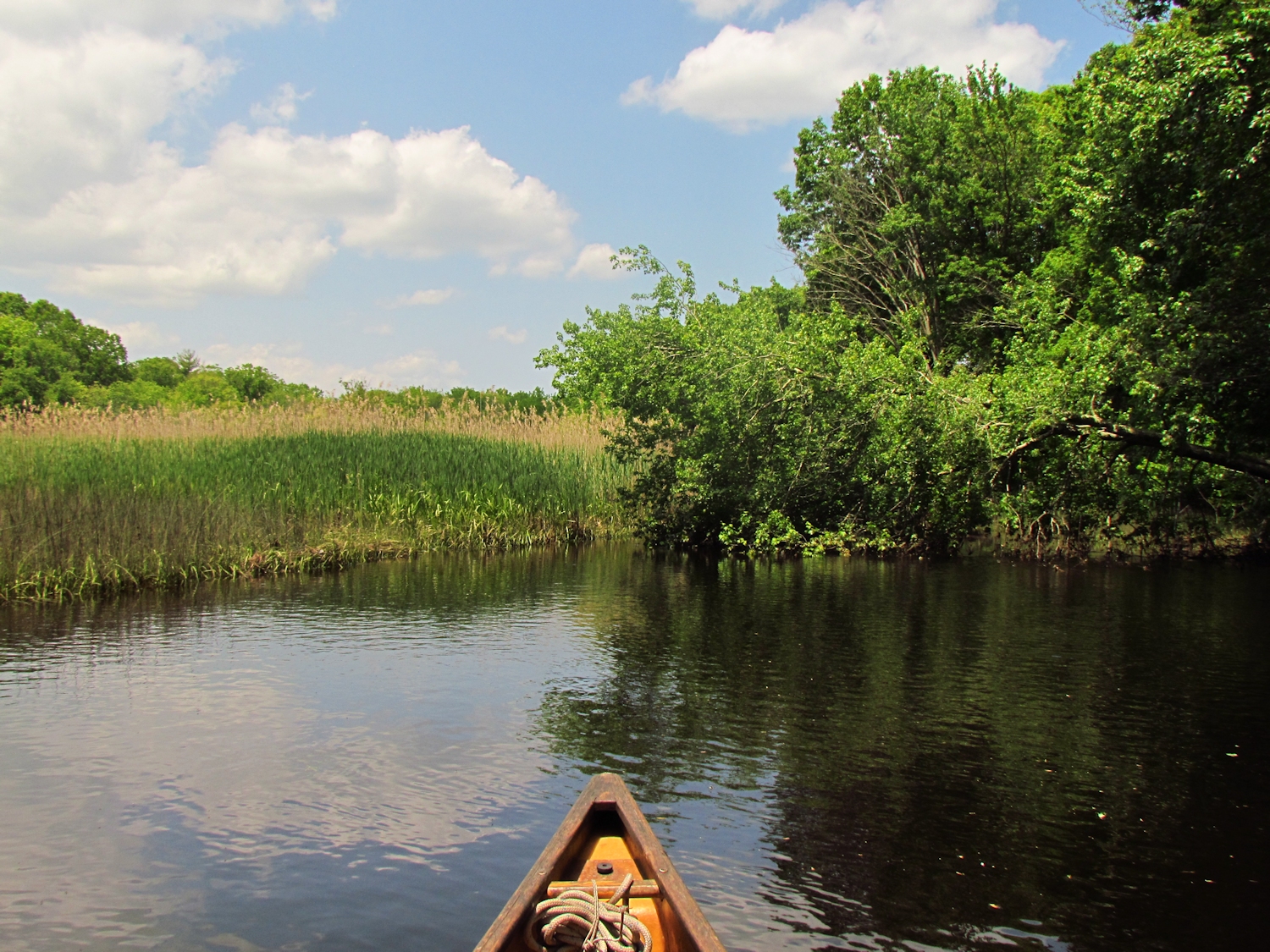
Friday, May 31, 2019

First Marsh Wren Nests

At the put-in I have a long chat with L, one of the state's safety check guys.  About this time of the year the state has a small crew that goes around to the state boat launches to do some basic safety checks and give people information about clean boat policies that reduce the spread of aquatic invasives.  In turn, I give L a short lesson in Willet behavior, which the Willets demonstrate in a timely fashion.  Sentinel birds, Willets are first to challenge intruders and also alert pretty much anything in the marsh with their calls.  We watch a couple Willets chase a crow away from the nesting grounds.
Willet
There is an onshore breeze with the ebb about an hour in progress when I head up my preferred route towards the Sneak.  I pause at the first bend in the Neck River and note that the wind and ebb flow are canceling.  The canoe spins sideways to the wind, but  drifts neither up or down the river.  With the temperature in the mid 70's and the sky mostly clear, the wind is a fresh and positive addition to a fine day.

Just a hundred yards up the Neck a Black Bellied Plover crosses the river leading me to spot another half dozen in the spartina.  While I fumble with my camera, they flush and it turns out that it is a flock of about 40.  They swirl a couple of times and then settle a 100 yards farther away.

Marsh Wren
The Sneak is unusually quiet with much less Willet activity than I expect.

Marsh Wren nest
I continue up paddling through the middle marsh with little to report other than frequent calls from usually hidden Marsh Wrens.  The vegetation isn't yet tall enough in this area to be building nests, but the birds are here.

Above the arch bridge near the sawmill dam ruins I find a Wren nest.  Cattails take over from the spartina above the arch bridge and the cattails are about 4 ft high, tall enough for a nest.  I check closely and confirm that there is new green cattail woven into the ball - it is a new nest.  A bit further and I find a second, although it is far enough from the first that it has to be a second male's work.  They will build between 6 and 20 nests before mating occurs and as I can only spot one it is a sure bet that the nest building period has just started.

Above Foote Bridge
I continue up to Foote Bridge before returning with nothing particular except for being vigorously scolded by a Red Wing Blackbird.  I made a note of the location and watch for a nest on the return but spot neither a nest or that Blackbird.

It is a fine and fairly swift return riding the ebb at near full speed into a moderate wind.

Wednesday, May 29, 2019

Quinnipiac River

It rained hard last night but the day turned out good with warm temperatures and a light wind and a thick overcast.  It's not a good photography day.

I set out upriver on the Quinnipiac from the top of the dreaded phragmites section.  That part of the river is just like paddling through a cornfield, yet it is the most recommended stretch.  Heading up the river takes on a wild feel if one can filter out the noise that comes in from nearby highways.  It's difficult for a person on foot to reach the river in most places.  In fact, from the river the bank looks quite jungle like.  It is rare to see anyone in here.

The water is high but the current is moderate and it is easy going up against it.  Osprey are overflying the river fairly often and Red Wing Blackbirds are calling out from the cattails and shrubs. 

About 45 minutes up the river is cut banked and some fairly tall trees can tumble in and block progress.  With few paddlers in here, sometimes the blockages never get cut (and some of them are definitely chainsaw sized projects).  I never know how far I can go.

I zigzag through two or three tangles and cut a couple of limbs before getting to a deadfall (a bit over one hour out) that will have to be clambered over.  The distance is good enough for the day and I turn back.

Sunday, May 19, 2019

Wheeler Marsh Bird Check

I set out with S into the Wheeler Marsh for a short distance trip of bird observations.  The tide was very high as we started and the usual delineations of land and water were well submerged.  It was overcast and near 70 degrees with a light wind out of the south.

The spartina has barely begun to grow, so views were long.  The numerous swans stood out, the unnesting ones contained to a certain territory by the two or three pairs of more aggressive nesting swans (I know where two nests are, but I suspect a third).

We headed up to Milford point noting a large number of Brandts in scattered flocks.  There calls gave them away without resorting to binoculars.  At the point we came across an odd colored duck and it took me awhile to figure it out once we got home.  The orange eye helped ID it as a nonbreeding female Long Tailed Duck.  They winter here in the sound and I did not expect to see one in May.
Nonbreeding female Long Tail Duck
From there, we headed out onto where Nell's Island should've been, searching for any high spots of ground where the wading birds would be collected waiting for the tide to drop. 
Some Black Bellied Plover and a bunch of Dunlin
Heading up river over the top of the island we stopped to watch a pair of Swans fortifying their nest by grabbing mouthfuls of floating grass and adding it to the pile.
Swans sprucing up their nest
I spotted the root ball Osprey nest that I first saw last year.  It is in use again and looks fine.  It is in a cleft that comes off of the main river channel.  All of the Osprey are looking good and I still think that there are more in the marsh than in previous years.

We rounded the top of the marsh and paddled out.

Friday, May 17, 2019

Shephaug Eagles and Beaver

We put in in a deep forested cove.  Winds were coming up as we loaded up and set out and the forecast had been for gust up to 20mph, so I kept a weather eye.  But as it was, it stayed surprisingly calm with overcast skies with more cottonwood seed in the air than raindrops.  In fact, the wind was light enough that it did not break up the film of pollen and other plant duff that had formed in the inlets and along the shoreline.


We turned up the Shephaug and followed the heavily forested shoreline noting an occasional trash item for retrieval on the return and watching for wildlife.  I spotted a quite distant Bald Eagle and was trying to point it out to M without realizing that she was watching another eagle about 50 ft up in a tree that was just a few tens of yards away.

In the next cove we found a very active beaver feed zone with quite a few well felled trees, each of them thoroughly stripped of branches and some of the boles stripped of bark as well.  However, we were unable to locate their bank burrow (there would be no conical lodge in this type of water).

Just after we started our return, I spied a Bald Eagle Swooping at the water about 600 yards distant.  Typical of hunting maneuvers, we watched it splash down on the water at something.  Then, it landed in the water.  It had something much too heavy to fly with and it began a flopping swim to shore with its catch firm in the talons.  The swim was about 75 yards or so.  By the time it reached the shore we were close enough to see that it had a 10 lb carp, which it was already tearing into.

After a short watch, we collected the previously spotted trash and made our way back to the put-in.

Thursday, May 16, 2019

High Water in Salmon Cove

I had a hunch that they would be over here on this side of the river although I had never seen them.  I picked up the scent before seeing any sign. 
Garbage haul - messy pebble flotation foam
I set out on the highest water that I've seen on this part of the river.  Full sized drift tree trunks that littered the parking lot showed that the water had been at least three feet higher during the last few days.  I diverted my usual paddle up the river into a day of exploring the interior of the swamp.  Narrow channels that normally were too thin for a canoe were easy passages, although they always ended up being dead ends. 

There are now four Osprey nests, all in the lower end of the cove.  Three of them are naturals - built in trees, while the fourth is a platform nest. 

I headed up the river side of the cove, which is separated from the river by a long strip of cedar swamp.  The first inlet into that swamp ran about a 1/4 mile before vegging out.  I found out that there was a long shrubbed berm that blocked a shortcut back into the cove.  I suppose it might have been old shoreline at sometime. 

Soon after heading back up the edge of the swamp I caught the scent of castoreum lingering on fairly calm warm air.  A couple canoe lengths further, I spotted a very large beaver lodge, which I was able to paddle right up to and around.  Even with the high water, it was 5-1/2 feet tall, figure 7 ft at normal water levels.  This would be a fully developed colony, 2 breeding adults, a couple 1-2 year old adolescents, and a couple first year kits.  There was a good amount of winter food still in the water (in climates where ice forms, saplings and branches are stockpiled in the mud as a food supply for iced in conditions) that they did not need to use this winter. 

Big Lodge
I continued along the edge and found a second lodge a couple hundred yards away.  This one was ramshackle and I could not be sure if it was in use.
Ramshackle Lodge
With the high water I was able to explore the wetland in the corner of the cove, which turned out to be quite scenic with bouldered hillsides and a small cascading creek.  There was also a small beaver lodge.  Based on the size, the inhabitants were probably not breeding yet.  I caught a glimpse of what was either a small beaver or a large muskrat and also noted recent beaver cut trees.
The gates of the Moodus
I headed up the cove and into the Moodus River.  Downed trees that I normally duck under were walling off the upper half of the short trip, which I am familiar enough with not to have to go clambering over logs.  There is another large lodge on the bank up here...definitely a breeding colony.
Moodus Lodge

Tuesday, May 14, 2019

The Headless Baby Doll CultL

I set out on a very high tide with near calm air and overcast skies that carry a minor threat of rain.
to the backside of Cat Island
I was tempted to cut across the marsh, today being a rare day when the marsh is much more water than land.  Instead, I head up to round Cat Island, a possibility only at the highest of waters when the narrow channel between the two areas of dry land will let a canoe squeeze through.  This end of Cat Island is also the most likely location of the Headless Baby Doll Cult, which to my knowledge has never before had contact with the outside world.  One of the two artifacts from that society that I have collected came from the eastern end of Cat Island while the other was found in the river about a mile away.  Little is known about these people other than their social custom of removing the heads from baby dolls and discarding the bodies in marshes.  It is possible that the collected baby doll heads were used for adornment on that peoples Schwinn Stingray bicycles, but there is no evidence to support that.  Today, I find no new artifacts, and make no contact with the people.

Least Sandpiper
One way that the Wheeler Marsh stands out, and it is something that took me awhile to figure out, is that the bird diversity is superior to many of the places that I would rather canoe in.
Least Sandpipers, Black Bellied Plovers, Ruddy Turnstones, a Dunlin, and Short Billed Dowitchers
After rounding Cat Island, I head diagonal across the marsh to Milford Point, then upriver against a stiffening current in Nell's Channel and back around to my start point. On the diagonal I flush several large flocks of tiny Least Sandpipers.  They difficult to spot in the dead spartina grass until I get close enough to flush them.  There's a good number of Swans at the lower end of the marsh (the Milford Point end) being held at bay by a pair of nesting swans.  I spot a pair of Oyster Catchers there as well.  As I cut back over to Nell's Channel I find a large collection of various shorebirds all on one long narrow spit of exposed mud (see photo above). Osprey are up at the top end of the marsh where they have two or possibly three nests.

Just as a I reach the take-out, a Bald Eagle flies over.

Wednesday, May 8, 2019

Contentment

May 7, 2019
It is a fine day, warm and fairly calm with a golden tinge to the sky that perhaps comes from a light film of clouds.
We put in at the bottom of the river while the tide is at its peak and head up our preferred route, the Neck River, Bailey Creek, through the Sneak and then the East River.  The spartina expanse is still brown and dominated by last year's growth, but when I look closely I can see the new green starting to come up. 
Willet
But, the most noticeable sense in the marsh is the sound of birds.  The Willets have all arrived at this point and their piercing calls come from all directions without puase.  They are seen most often in pairs and when flushed fly off together, so while mated, they have not yet nested.  They seem to be in the last of the nesting territory squabbles, still more concerned about other Willets than about the intruding canoeists.  In between the calls of the Willets are the whistles of the Osprey.  They were the first to arrive and it is clear that they have eggs in the nests as each nest has one Osprey that stays put as we pass by.

Willet
At the Big Bends we find a condensed flock of Yellow Legs, smaller than the Willets with a different call.  At a distance, flying is when they are most easy to identify as only the Willet has the beautiful black and white barred wings.  Also in attendance were a few Snowy Egrets and a couple of Great Egrets.  We had a possible juvenile Little Blue Heron sighting as well.  They are white in the first year and similar in size to the Snowy Egrets.  But, they lack the bright yellow feet of the Snowy.

We turned at the arch bridge, mostly because the warm calm air made the two of us feel quite content and we did not see any good reason to leave that disposition.  The Sneak was still passable on our descent, so we retraced our outward route.