Sunday, March 24, 2013

Lost Baggage

I get roped into a silly problems all too often and dwell on them longer and harder than they are worth.  I carry one with me as I canoe until I reach Pond Point, the first point south of my put-in.  The question of who Pond Pt. is named for takes over.  There is not much value in the question, except to me.


There seem to have been hundreds of people named Pond here in my new town, and I suppose that many of them are related and some are not.  The Pond that interests me is not likely who the point is named for, because although he is a historic character, the rumor of a murder minimizes that likely hood.  The mother of this Pond is buried along with two of his siblings in the oldest cemetery in town.  She has been there over 250 years.  Her son, Peter, is the one of interest.  Born here, his claims to fame occur far away being the first European to cross the Methye Portage, which means little to most.  That portage, some 13 miles long, is by today's standards, a long way away and in a still remote location.  It is the longest "required" portage to cross North America from coast to coast.  Peter's route to the Methye was through Montreal, the Great Lakes, Northern Minnesota, Manitoba, Saskatchewan and finally to the portage itself, in northern Alberta.  It is an almost unfathomable distance to be made, for the most part, by canoe...birch bark canoe.  Peter is supposed to be buried here in town, but no one has figured out where.  The point is probably named for the Pond that became governor.  I have no idea what he ever did.

C224 is paired up and hanging out in Calf Pen Marsh


Turning the point, the land no longer protects and a stiff offshore wind confronts me.  I paddle as close to shore as possible and, with the high tide, turn into Calf Pen Creek to continue my exploring.  It was ice choked the last time I went in and I didn't get far.  At the mouth are hundreds of gulls, but this time I notice that many of them are small Bonaparte Gulls, which I haven't noticed before.  I follow the creek passing under the second bridge into new country and continue as it narrows until it is blocked by both deadfall and lack of water to paddle in.  I return to the sea.

Calf Pen Creek


I continue south to Welches Point and turning that I find that offshore wind full in my face and slowing me to much less than a crawling pace.  Getting to Gulf Pond, a distance of a half mile or so, will take more than an hour if the wind doesn't strengthen.  I turn back.  My problem resurfaces, and in a moment I realize that it is of my manufacture, an error on my part, and other than setting the record straight, it goes away.

Thursday, March 21, 2013

Boat with a Heater

It's cloudy with a sun that barely burns through high clouds, an visual effect that becomes arctic with the cold dry snow that slowly falls seaward.  The wind is out of the north for the most part, but somewhat onshore and I paddle into it and the chop that is something less than a foot.  I dig into my pack and pull out my gloves, my fingers going uncomfortably cold in air that dangles just above freezing.  


At the first point, the one with numerous rock islets, I pause, protected from the wind.  There are few birds around today.  Gulls and brants for the most part.  None of the long tailed ducks that I've seen here before, and I know that things will begin to change as the migration comes on, but maybe that is a week or two off, yet.  I suppose that it has started for some.

The snow stops and then begins again.  I decide to continue on up to the Oyster River, which lies in the next cove.  As I round the point, I spot four swans in the distance.  We have the introduced mute swans in this area, but this is also a flyway and trumpeter swans migrate through at this time.  I close and see that with the obvious orange bills, these are mute swans.


As usual, in these winter conditions, I have the water to myself, and for that matter, I almost have the shoreline to myself, seeing just a couple people during the whole trip.  But farther out to sea, the clam boats are running their dredges.  I count seven within view.  I also count four loons, although they are too distant to determine their specie, and it is too cold to bother with paddling nearer.  But, low in the water with their big head held forward as if they were intent on going somewhere...they are loons.


I near the mouth of the Oyster River and find the water too low to enter without a portage.  The tide is about half height at this time, so the Oyster River will be a high tide trip much like my Indian River trips...entering as the tide nears high, and leaving within two hours on the ebb.  

I turn back.

Nothing happens except that a carpenter, working on one of the storm damaged houses, yells to me, "Does that boat have a heater in it?" 


Wednesday, March 13, 2013

I did not write

I did not write anything while in the canoe.  I went to the West River for the first time.


Four great blue herons.  Three common mergansers.  Quite a few red-wing blackbirds.  Calls from songbirds all around.


There was a strong current in places that made the trip upstream just barely possible.  It might have been the low tide.  It might have been the heavy rain from yesterday.  It might have been both.  It might just be the way things are.


I did not feel like messing with the big straining downed tree at the Derby Avenue Bridge, and I did not feel like portaging over the road.  So, I drifted back.  Whatever it was that keeps me from making stuff was gone.  The canoe had done everything it was asked of.


Sunday, March 10, 2013

A New Paddle Day

A cardinal sings unseen as I begin my trip.  Yesterday was the first nice day after the recent storm and the birds were no where near as active as they are today.  I have a new paddle out today, one that I just finished last week.  The oiled shaft is still rough on the hands, but it is a good paddle, as good as my favorite and it slices cleanly through the water when I feather it.  I find a large mixed flock of seagulls and ducks at Welches Point.  I move on because I am heading to the big river and timing the tide correctly makes life easier.

Side 1 - map

Side 2 - common loon and call wave plot


The last time that I was here in the big marsh at the mouth of the big river, I spotted a dead dear lying along the shore hidden a little by the phragmites, the brush, and the shade of the overhanging trees.  S was with me on that trip and she was still excited about seeing three live whitetail deer moving through the marsh, belly deep and not so far away from the canoe, so I just kept my mouth shut and we passed by without her noticing.  I pull over to where I think that the deer was and I find the ribcage, leg bones and the skull along with remnants of fur.  There is something disturbing, but there is also something hopeful in it all.  It is nature, it is natural.  It is what it should be.


The water in the marsh is very high today and instead of the maze of spartina islands that I have paddled through in the past, it appears more like an open bay with just the top few inches of grasses showing in places.  Canada geese are plentiful, much more so than previous trips, which were during the fall hunting season.

Good weather arrived yesterday and this trip started at the house in sun with a NE wind mostly at my back and somewhat onshore.  The water was mostly calm until I had passed Charles Island and no longer had shallow bays to dip into and hide behind the points.  I reached the big river just as high tide peaked and I paddled over the broad sand bar saving myself a half mile detour out into open water.  The high water gave me a good chance to explore Beaver Creek for the first time and I followed it until it reached a bridge that was too low to pass under.  The highlight of the exploration was a red breasted merganser that was surprisingly calm in my presence.


I fight the ebb current upriver for the next mile or so.  At times I can find slack water or an eddy along the shore, at times I have no choice but to paddle straight into it.  Near the old power plant, I push off of the creosote pilings with my paddle every so often.  A sharp crack reprimands me for that act and the new paddle now wears a split in the tip...it is disturbing, but there is something hopeful in it.

Tuesday, March 5, 2013

The Eyes Have It

As a boy, I could never quite figure out how my dad, when we were out duck hunting, standing in a marsh or walking from pothole to pothole, I never could quite figure out how he could identify a flying duck speeding towards us.  At the time, they never looked like much more than a big, fast, dark bird speeding across the sky.  There never seemed time to look at it and figure out what it was.  I find that I have become that guy who can spot a duck at a improbable distances and tell someone what it is.  Now, the joke is on my wife and friends, who imagine me to have especially sharp eyes, eyes that have magnifying power.  They see a dark and white spot out on the water and point it out to me and I'll say, "that's a merganser," or "that's a bufflehead," or "that's a plastic bottle."  I don't know exactly how I do that, but it has not so much to do with the eyes as what you do with the eyes.

brants


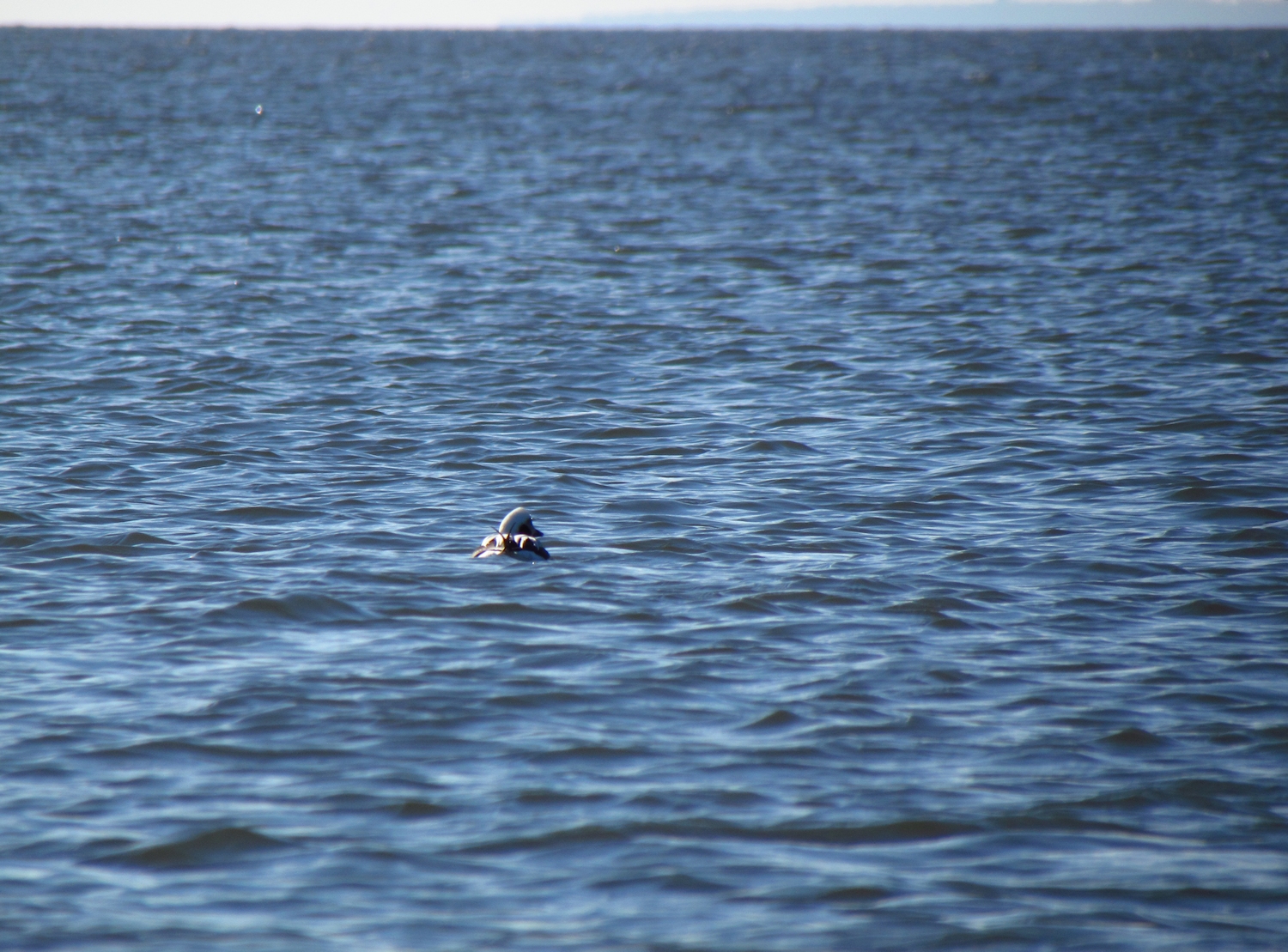
I hoped that I might find the long-tailed ducks near the rocks at the point that forms the far end of the next bay up the coast.  It is nearing a low tide and the last time that I saw them, it was a high tide.  Some birds move around with the tides to get optimal feeding, so I did not have any reason to expect them.  The wind was from the NW today at a brisk 10mph or so.  That meant it was a somewhat offshore breeze and while I had to power into it, it did not create waves other than a skimming chop.  But, even with a windchill that numbed my fingertips and stung my ears, it was sunny with a brilliant blue sky.   At the rocky point, I found brants sitting on the rock ahead of me and to my left, watching me and waiting for me to get too close upon which they will fly to their next favorite feeding spot up the shore.  In the gap between that point and a rock islet were four long-tailed ducks.  They are a backward duck, wearing their best colors in winter and their drab colors in mating, just the opposite of other ducks.  I aimed my camera (the only thing I aim anymore) at one and it dove.  Long-tails are the deepest diving of all ducks.  It was down an unlikely long time.  I did not see the purple sandpipers this time.  They had been on the edge of an islet on my last trip...it was a new bird to me and I hoped to see them again.

long-tailed duck


I decided to continue to the mouth of the Oyster River, which is in the next bay.  I had seen loons here on my last trip and I saw them once again on this one - one red-throated and a pair of common.  The common loons thoughtfully identified themselves by calling.  The closer that I got to the Oyster River, the stronger the wind.  It funneled straight out of that low spot requiring firm paddling until the water became so shallow that I could not get a full paddle blade into the water.   But, I now knew the lay of that river mouth and, like many of the small rivers here, it would always be a wade at low tide.  I could turn back.

I returned on a downwind.  The purple sandpipers, seven of them, were once again sitting on the seaward side of that islet as the wind blew me past.

Thursday, February 28, 2013

Where the Spirits Are

I am still a visitor in this place.  I can feel, and see, in my notes that I have not yet crossed over into where the spirits are.


Finding the spirit in nature has never been as easy as stepping out of a car at a scenic overlook and oohing and aahing at the view.  It takes effort and more than that, it takes time.  It is observing until noticing becomes knowing, where knowing is not simply the facts, but knowing inside yourself where you are in as many different meanings as you can conjure up... and in many meanings that you cannot.  In fact, knowing the facts isn't all that important.  It is becoming aware and opening all of one's senses, especially the senses that biology has not discovered.  I have not put my time in for that, yet.


I miss the water mammals most.  The otter and harbor seals, and especially the beaver were spirit animals for me in my west coast travels.  They were creatures that helped one cross the boundary.  I have not seen any of them here, yet, but I do see loons.  They winter here and they are a power to be reckoned with.  They will lead somewhere, I will follow.

the smaller red throated loon


I put in on the calmest day I have yet seen here.  Long Island Sound is almost glassy smooth.  Low overcast disappears the horizon.  The tide is rising but will be of little interest as I head up coast.  I push brants ahead of me at each rock outcropping and when I get to the next point, where there are rocky islets, I find a few long tailed ducks.

the larger common loon

As I cross the next cove, new water to me, a common loon calls to my left.  It dives and a few moments later surfaces to my right, perhaps a swim of 150 yards.  It continues to vocalize as it swims off, its head rising just a bit with each call.


When I get to that next point I recognize it as the neighborhood that some new friends live in.  I round the point until I can see New Haven in the distance.  This is far enough.

Monday, February 25, 2013

Timing for the Indian River

I've learned through trial and error (pretty much how I learn anything, by the way) that canoeing the Indian River is mainly a matter of timing the tides.  Canoeing on the coast, as I do, is a routine of checking the weather forecast and checking the tide tables.  Today, with a morning start, I can arrive at the stone bridge entrance to the Indian River at some time pretty close to high tide.  And that means I can paddle under the bridge on a flood current instead of wading in cold water and pulling the canoe through.


A light off-shore breeze that sometimes lays on my back makes for an easy and pleasant trip along the seashore.  Five months after the hurricane and I still pass dozens of houses in various states of un-inhabitation with plywood over windows and blue tarps stapled to former roofs.  At near high tide, it is easy to see the problem...the storm math is straight forward.  The houses clear the water by maybe four or six feet at high tide.  High tide comes twice a day, and so, it will come twice during a big storm.  High tide + 8 feet of storm surge + 8 feet of wind waves =  pounding wave driven water in the second floor of many houses.  Nice place to visit, but I wouldn't want to own one.  They're actually quite affordable, if you can afford to rebuild a house once in awhile.

I ride the flood current into Gulf Pond with no effort other than to bend over and lay my chest on the center thwart as I slide under the rusty bridge.  Here, in the brackish tidal marsh are the Canada geese and buffleheads.  I pass the second bridge as I did the rusty one.  The third bridge is a bit tighter, but I know to stay to the left where it is just an inch higher.  With the stone bridge, headroom is never a problem.  Instead, it is the height difference of the bottom, the Indian River side being about 18 inches higher than the Gulf Pond side.  But, the tide, both coming and going, backs up at the narrow passage.  If you time your coming and going right, it is downhill in both directions.

the second bridge


The Indian River starts with a broad wetland, but, at the highway bridge, necks down to a placid tree and brush lined creek that would be an fine hundred mile trip, if there were a hundred miles of it.  When you see wildlife on rivers like this, you see it close, if only for an instant.  Ducks are surprised as the bow of the canoe rounds a bend.  A white tail deer runs off after seeing my motion.  A hawk just sits as I pass under, not threatened by me, but probably a bit perturbed about my alarming its prey for a minute or two.

In the Indian River


The fifth bridge is always the lowest.  Going up I just lay in the bottom of the canoe and push myself under.  Returning I have to wait for 45 minutes for the tide to drop before I can repeat the trick.