I headed out up above the Shelton dam, putting in at the state park. A strong thunderstorm came through the area before dawn and more were predicted in the afternoon. I was in the water about noon, headed upstream for an hour and returned, with more than enough time to take out before the storm, that never arrived.
Tuesday, September 13, 2022
Between Storms
Saturday, September 10, 2022
Bird Watching
I invite M to come over and do a bird watching paddle with me in the big marsh. We have a very high tide today, but the air is calm and the day is just plain pleasant. We head out somewhat early, timing the trip, first, so that we will be there before anyone else, and secondly to catch the earliest of the incoming tide.
![]() |
| Juvenile Night Heron |
We reverse and head back to the east to scope out the trees. Now, there are ten Great Egrets perched in the branchy dead tree. I expect to find many Night Herons, but it is only four or five.
Now, we can head back into the central phragmites patch. The water has been rising fast. We stop talking and ease in. Today, the birds are a little farther in, near the floating reed mat. But, we flush 10-12 adult Black Crowned Night Herons and a Great Blue Heron. Still not enough water to push through the reed mat, so we back out and head down to Beaver Creek.
The creek is fairly quiet. We find a Green Heron and some Snowy Egrets, until farther in, a large mature Bald Eagle takes off and flies through the trees and away.
Heading out, there is a pretty good flood current against us in the creek. The water is high enough to cut the corner into the river, which turns out to be a good plan. About a dozen adult Yellow Crowned Night Herons are perched in here. The return upriver is easy with a good flood current under us.
Friday, September 9, 2022
First Harrier of Late Summer
It is a fine morning with a near maximum high tide sometime around noon. In the lowest few miles of the Housatonic, the incoming tide reverses the river current, and not just by a little.
Today's trip is perfectly timed to have me paddling against a 4 mph incoming flood tide. this isn't as hard as it might seem, at first. All that one has to do is hug the shore and hop from eddy to eddy until reaching the marsh. What surprises me today is that with the especially high tide and stronger than normal current, the entire east shoreline, all the way to the marsh, is one big eddy. I make the mile to the marsh in under ten minutes.
It is still early with almost three hours to high tide, but even now the marsh is fairly well flooded. I head in to the center using my shortcut to approach the central phragmites patch, always a good spot to see birds. I end up flushing at least fifteen Black Crowned Night Herons, several Yellow Crowned Night Herons, one Great Blue Heron, and a Clapper Rail. Seeing that many Black Crowns is unusual, as is the Clapper Rail sighting.![]() |
| Black Crowned Night Heron |
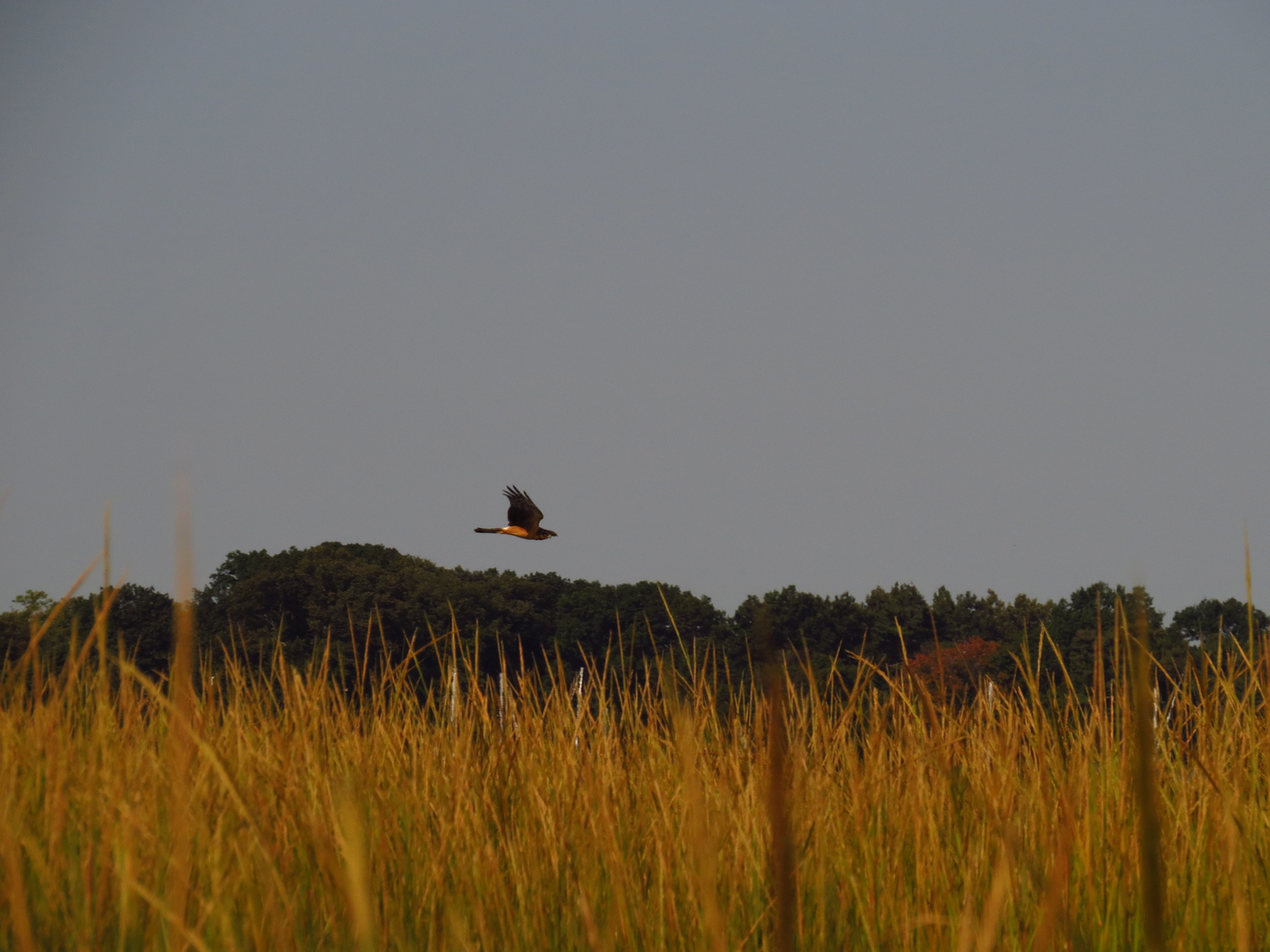
As I continue, I spot a Harrier actively hunting. It's skimming low over the marsh, pulls up into a brief hover to look at something, but then continues on with its low level hunt. It's been several months since I've seen a Harrier. It might be that the Osprey keep them away during their nesting season.
![]() |
| Harrier |
I hear a kayak navy setting sale from the wildlife refuge launch, so I lay low and head back into the inner channels. until they've moved on. I reverse my track as best as I can, finally locating the "impenetrable" weed mat - one of the few landmarks in the marsh. That connects me to known channels. I head out and ride the flood current back up river.
Thursday, September 8, 2022
Reboot
I head out down Pond Brook, which actually is Pond Cove, this tributary of the river being in its third phase, not unlike myself, I suppose. I don't imagine that the brook was ever canoeable. It should have been too steep and rocky, if it ever had enough water. Its second phase was a railroad line running down the left shoreline to where it crossed the Housatonic and turned up the Shephaug. It must have been one heck of a scenic train trip. The current phase started in the 1950's when a dam was built about 3 or 4 miles downstream. The reservoir water then backed up into the brook making it a cove. It also submerged the old rail bed except up at the top of the ponding.
I didn't sleep well the night before, so yesterday was a low energy day with a lot of napping. I even watched all 12 innings of a pretty good baseball game. So, the morning start was just a little delayed as I had to burn some energy off the cats. We had a good half hour of sliding across the hardwood floors and dive bombing imaginary critters, and then I could go.
It is exceptionally peaceful today, although not quiet as the forests are filled with cricket calls. I head down and round the point into the Shephaug. I noticed some horse chestnut trees, and then paid attention and realized they had acorns. It's one of those oak trees that has leaves that I don't associate with oaks and I identify it when I get home - a chinkapin oak.![]() |
| Chinkapin oak |
The wind is supposed to be from the NE today, but right now it is out of the south. That turns out to just be some hill affect, and soon I have a light cool breeze in my face. I usually follow the forested west shore when I head this way, but today I decide to cross over so that I can scan the forest from a distance. I spot a hawk very far off and confirm the sighting when I spot ten Vultures soaring at about the same distance. Vultures have more dihedral in their wings. There are also quite a few Great Blue Herons and when I pay attention, a lot more Ducks than one might think. They are mostly Mallards.
I don't see any other boats until I get up to the final bends below the cascades - two fishing kayaks and a bass boat. I've made good time and take a short break in below the cascades, then head back down. The bird count on the reverse is pretty much a duplicate of the bird count on the way in. I see three more fishermen, and it remains peaceful.
The head has been rebooted and all is right side up again.
Monday, September 5, 2022
Marsh Morning
I'm up and out the door early. I've been watching the weather prediction since yesterday and it has gone during that time from chance of thunderstorms all day, to no thunderstorms and some rain, to mid-day thunderstorms and rain. So, an early start was best. This isn't a big deal for me. I canoe often enough that I have a "canoe" pack that stays packed and ready to go. At this time of the year, it has rain gear, a water bottle, some snack bars and a first aid kit that probably needs first aid at this point.
I break camp in my usual efficient manner - I feed the myself and the cats, spread a 1/4 cup of bird seed on the back porch - this is kitty cartoons, as soon as they've wolfed their food, they crouch at the glass door watching birds and squirrels. Then, I grab my pack and I'm out the door. I head to the local big slat marsh - this is the end of a Labor Day weekend and driving any distance on the highways will be punished.
The morning sky is a thick overcast. The air is humid but cool enough that it is still pleasant. I set out a half hour after high tide heading down river to the salt marsh.
With the water still high, I take an inner path through the center of the marsh. There are very few birds visible due to the tide level. There is almost no exposed mud to feed from, so most of the birds are hidden away waiting for the dinner bell. When I see birds, it is either because I've flushed them from the spartina, or because they were up and heading someplace. It's a few Night Heron juveniles, a few Sandpipers, a few Ducks, and a couple of Great Egrets, until I get into the lower east corner. There, I flush about a hundred Canada Geese, most of which I did not see until they took flight from behind a small island. I headed over here because I figured that I might find a bunch of Egrets and Night Herons in the trees on the east shore. I spot about a dozen or so, and in the heavy gray light, I figure I just can't see another dozen. They disappear in these overcast conditions.![]() |
| 7 juvenile Night Herons and one Great Egret |
I take my shortcut on the way out, and meet a pair of paddleboarders. A quick greeting is that none of us have ever seen anyone else this channel.
I cross the river and head back upstream doing nothing unusual other than running a lap around the railroad bridge abutments.
The weather forecast has changed again by the time I get home.
Saturday, September 3, 2022
Salt Marsh Geomorphology Part 2
I headed out early for a quick trip through the marsh. Being a Labor Day weekend, anything but an early start would put me in the midst of the motorboat Rock 'em Sock 'em Robot festivities. The weather was excellent, and with a falling tide I had to keep moving if I was to get through the marsh.
I made the down stream trip to the top of the marsh in under ten minutes - it turns out to be 60 ft. short of a mile, so yes, I had some current behind me.
I head in for a clockwise rounding of the marsh. The birds are more a constant than overwhelmingly numerous. The tide is already well down, so the 1-1/4 mile diameter marsh now has twenty-some miles of exposed feedable mud, so the shore birds should be well dispersed in a lot of places where I won't see them. But, there are always a few Yellow-Legs, Egrets, or Night Herons to be seen.Near my secret short cut I find a long piece of old rubber. It's eroding out of the bank about 2 ft. down. Old rubber, from my experience, has a creepy gelatinous almost anatomical feel to it. I found a model-T tire once. With all of the cord rotted away, it was soft and kind of gooey in a way that more modern rubber doesn't get. That's my dating process for this piece of found rubber. It's hard to say what it originally was - probably a tire, maybe a hose.The sun is still low and although it I didn't actually get here early enough, there is nothing better than a marsh waking up. It is cool with long shadows and the wildlife is about as calm as I am, if for no other reason than it is too early for anyone else.
Near the top of the shortcut into Nell's Channel, I find a bottle poking out of the cut bank...more data. Although the bottle was buried in one piece, weather or weight of the marsh has broken it into three pieces. I am able to reach back into the mold and get the base. Later I'll identify it as a Foster-Forbes made beer bottle from 1972. It was 20 inches down from the surface.
![]() |
| 1972 Forbes and Ford bottle |
It occurs to me that I've managed to switch on my "seeing mode," that place where I focus on details that ordinarily sneak by.
![]() |
| The hard to read FF logo of Forbes and Ford |
I head up Nell's Channel following the river-right side. There are some tiny biting bugs, no-seeum size. I find another bottle eroding from a cut bank, about 15 inches from the top. It's 19 degrees magnetic (forgot my good compass) to the Milford coal stack. It's double handled with Penick and Ford Ltd printed on the bottom. Later, I identify it. Penick and Ford made maple syrup. The makers mark is the Owens-Illinois "diamond-I", which dates it to 1941-1955.
I head back out and upriver against a current that is dropping off as the low tide approaches.
Friday, September 2, 2022
The Boat Wreck Section
I stop to write, easing the canoe up against the sandy silt shoreline in a long relatively unused section of the river. A goofball on a jetski has decided to play with his toy in pretty much the same spot. The goofball looks bored. He pumps the throttle, goes upriver, turns and goes downriver, and pumps the throttle some more. He doesn't go anywhere, and I doubt that he has seen what surrounds him. Nature doesn't reward the easy solution. Nature rewards those that make, at least, a modest effort. Go home and play video games already.
A fleet of sea kayaks is setting out just as I am gathering my gear. There is a 50-50 chance that we will be paddling in the same direction...it's a river, after all. I take my time and make sure they have a good head start. I run into groups like this a couple times each summer. I'm glad that they are out and paddling, but to me, there is something backwards about paddling in a herd. I suppose they're thinking "safety in numbers." Robert Perkins (just a creative guy who's made some good canoe trip videos) said something to the effect, "people who tell you to never paddle alone, have never paddled alone."
![]() |
| The mighty Rocky Hill ferry at full capacity |
I head downstream into the section of boat wrecks. The river is sleepy, and 800 feet wide... always. The weather has finally dipped into the mid 70's with low humidity. There is a cooling breeze out of the north. Starting out downstream with a tailwind always has the possibility of a return that is a grim crawl, but I haven't been in this section for a couple years.
I cross the river and get into the shade of the trees on the east shore. I don't know why this section of the river has boat wrecks. There are no real hazards other than some large sandbars. There aren't any submerged rocks, sharp bends, or dangerous currents. The first wreck is on river right, an upside down runabout securely mired in the shallow bank. Next comes a cheap plastic rowboat that is missing the aft two feet. A little farther on is the remains of a 17 foot Penobscot. I'd like to have one of those (I have a 16 foot version). This one needs some work. After that is the upside down inboard runabout. It was there the first time I paddled here. Somewhere is a wrecked sailboat, but I turn earlier than normal due to the return headwind and I suspect it is farther down.
It has been good for Great Blue Herons - about ten sighted. Also, a couple Kingfishers and a few Osprey, plus I got to watch an Osprey chase a young Bald Eagle away from the prime fishing spot.
At first, the return is a grind. I thought it might take two hours to return, but I end up in some slow current (by chance) and the wind slacks off (the weather service was unusually accurate). I continue up a short ways past my start point just to extend the day a bit.