Saturday, March 5, 2022

Long Views

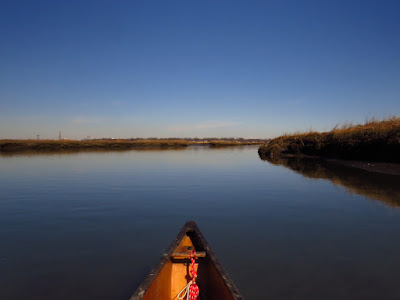
 It might, so far, be the best day of the year. It's hard to say though as there haven't been many good days for canoeing.  I put in with the tide still rising, the sky mostly clear with some high thin clouds, almost no wind, and temperatures in the 40's.

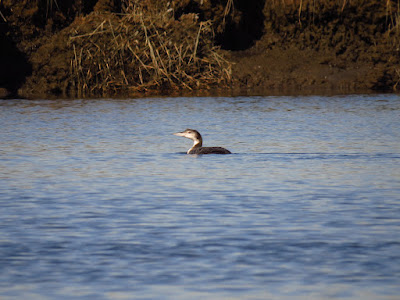
Just downriver of the first bridge are three Common Loons.  The checked pattern on their backs is returning.  Those patterns fade out during winter.

Common Loons - note the back pattern returning after winter

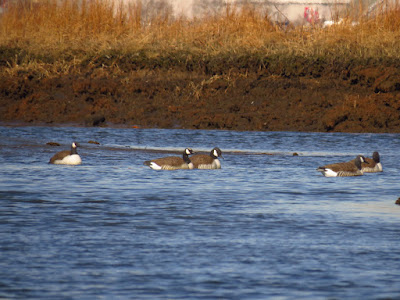
The tall spartina of the marsh was knocked down by winter snows, so with the high water, I have expansive views across the marsh.  And, for a change, I can see the layout of the smaller channels that weave and often dead end in the marsh.  There are a great number of Canada Geese.  They are up out of the water in flocks of 15 to 50.  I can only imagine that they are sunning in the pleasant conditions, not to different than myself.  I start with an estimate of 300 Geese, but as I cut down through the center of the marsh, I keep adding to that number.  I end with a guess of a 500 Geese.  My last trip through the marsh was during Goose hunting season, I spotted one Goose hunter and zero Geese.  Funny how that works.

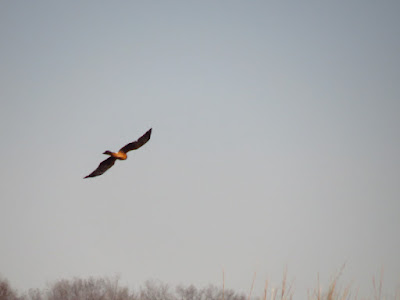
I get to the bottom of the marsh and head to the east.  I spot a Harrier, the white butt patch obvious, plus the fact that it was flying low like a Harrier.  Looking for a perch, it finally settled on the bank where I got a couple photos.  When I aimed my camera again, I saw the Harrier walking off into the brush.  But no, that turned out to be a red fox and the Harrier had retreated to tree perch.  I paddled on and the Harrier took the lead, taking one quick swipe at a pair of snoozing Black Ducks, but the Ducks escaped.  

Harrier, just before the fox enters the scene

I returned back through the center of the marsh.  The Loons were still fishing just downstream of the bridge.

Friday, February 11, 2022

Beat the Tide

I catch the middle of the falling tide and ride a strong current down to the marsh.  But, I paddle steady the whole time as I figure that I can just barely make it around the inside of the marsh before the water gets too low...and I get stuck.

It is the finest day of the year, with almost no wind, clear sky, and temperatures in the mid 40's.

There are very few birds about, just some Mallards and Red Breasted Mergansers, so the paddling is uninterrupted.  Even in the marsh, it is surprisingly quiet.  

Common Loon
The "height of land", so to speak, is the area north of the the Audubon Center.  More or less, this is where the tide waters meet or diverge.  It is just a few inches deep when I get there, so there is no time to lose.  I try to read the water, looking for a bit of current - that's where the deepest water will be.  I get through with just a bit of poling with my "rock" paddle.

Harrier
I head out into the river mouth, but there are still few birds other than Gulls and three Mute Swans.  I head back through Nell's channel.  I spot one Coot, three Buffleheads and a Common Loon, and then a Harrier that has taken off from Nell's Island. Farther up the channel I spot of flock of Geese.  They don't move as I approach...apparently, it is Goose hunting season.  Lousy day for Goose hunting in the marsh as I have not seen one during the entire paddle. 

Decoys

I spot one more Loon as I head back up the river on a slack current.

Wednesday, February 9, 2022

Winter Factors

The winter factors - wind, temperature, and ice.  Most of the new year has been less than good enough for canoeing.  Many days were almost good, with only one of the factors out of step - sunny days with 20mph wind, calmer days with temperatures in the teens, and the dreaded 35 degree rain days.  I prefer being outside on a nice 20 below zero day to being out in 35 degrees and rain.  

Finally, sun and light wind with reasonably warm air.  I put in under the big highway and headed down to the marsh.  I know the water will be open, unlike many of my other favorite spots which will still be iced up for a few more days.  The only shortcoming is that the tide is low and I won't be able to circle the big marsh.

We had a snowstorm about a week ago.  It only dumped a foot of snow here, but it came with 24 hours of 30mph wind.  The spartina grass in the marsh has finally been knocked down.

Red Shouldered Hawk...maybe
When I reach the top of the marsh I head up Beaver Creek hoping for half of the bird action that I saw on my last trip.  I almost miss it - paddling in and looking ahead, and there is a Red Shouldered Hawk sitting and watching me pass from a piling not fifteen feet away.  As I hit the meanders, I start spooking Black Ducks and Mallards, the usual mix that I expect in here.  Then, a couple Hooded Mergansers, then a Hawk swoops in and makes a try for the hen Merganser.  She dives and the Hawk immediately retreats to a tree perch a hundred yards off.  The hen plays it safe, swimming low - thinking small, and near the shore so that a second attack will have to come from a predictable direction.  But, the Hawk has given up for the moment.  I can't identify this second hawk even though I got a pretty good look at it.  It might be a dark morph of Broad Shouldered Hawk...but that level of birding is out of my range.

A couple more meanders and the low tide runs me out of water.  As I turn I spot a Sharp Shin Hawk streaking through the nearby trees.  I pass the Red Shouldered once again on the way out.  Unusually, it is just not perturbed by my presence.

I head up and just a bit past Cat Island where I run out of tide, as I expected.  A good enough trip I start back.  As I leave the marsh I find a mature Bald Eagle in a high tree perch and a Common Loon working the current near the lowest bridge.

Tuesday, January 25, 2022

The January Wildlife Show

I put in on the big river from under the big bridge, but first I talk for about 15 minutes with a guy from the highway department.  The WPKN sticker on my canoe tells him that we are fans of the same radio station, a free format station that is one of the best anywhere.  Anyway, he is the drainage guy for the department and is here to check on some issue.  We share some beaver stories, both of us appreciating the ingenuity of those rodents.  I point out a few Loons that are currently feeding near the bridge.  I suppose they are here because the current will pick up in this area as soon now that the tide is coming in. 

I turn up into Beaver Creek when I get to the top of the marsh.  There are no beaver in this brackish section of the creek and I think it has been some time since there have been any on the upper sections.  It's just an old name.

I flush small flocks of Black Ducks at each turn, maybe 12 or 15 each time.  The count totals a hundred within a coupe hundred yards.  Then, I spot a buff colored bird waddling back into a gap in the weeds.  It is a Bittern, a Dr. Seuss-like bird, shaped like a stretched out bowling pin and a rare sighting for me, this being only the third.  I can go home now.

American Bittern  


Fortunately, I continue to where the water goes too shallow.  At the next bend, I flush a dozen mallards, but a Sharp Shin Hawk sweeps in as all the commotion is going on.  There is a Green Wing Teal in the mix and the Hawk has picked it out as its next meal - Teal are a very small Duck - small enough for a Sharp Shin to deal with.  I watch three attacks.  Each time the Teal evades with a short flight and a quick dive.  They end up behind me down the creek.  

Green Wing Teal


Green Wing Teal trying not to be seen
 

As I paddle out, I spot the Teal in a side channel.  It was a very difficult sighting as the Teal is low in the water and as still as it would be if it were dead. It looks like a clump of mud sticking out of the water. I look around and find the hawk overhead a short distance off in a tree.  

Sharp Shin Hawk
After a minute, the hawk moves off farther downstream and the Teal begins to move.  I wondered if the Teal might be injured, because although it can fly, it did not fly very far when the hawk attacked.  But, I flush a second Teal as I head out and decide that a Teal taking off is not fast or maneuverable enough to evade the extremely nimble small Hawk.  It is a behavior that I've seen before with Bald Eagles hunting Coots. In those attacks, the only evasion for a Coot is to dive and wait for the Eagle to tire and fly off to perch.

Thursday, January 13, 2022

Finally, the Weather Lets Up


A calm and warm day showed up after a good solid two weeks of windy days with rain or snow that made canoeing out of the question. I put in on the big river as the tide is halfway to low.  I cross over to the far side, just for a change, and I follow the shoreline except when I have to paddle out around docks or give the oyster boats some room to work.  It is a fine winter day and birds, oyster boats, and one canoe make up all of the river traffic.


Hooded Mergansers

 Several Common Loons are in the middle of the river taking advantage of the current while they feed.  At the point just inside the river's mouth, where it necks down quite a bit, I cross back over and enter the marsh.  It is clear that hunting season is over as there are a few good sized flocks of Canada Geese and Buffleheads.  I can't round the marsh with the tide dropping, so I head for Nell's Channel.  I spot a total of six Hawks - two are definitely Harriers, one is definitely not a Harrier, and the other three are too far off to identify. Add a pair of Coots and a pair of Hooded Mergansers seen in the channel.

Harrier

We had six inches of snow a week ago, but it came down dry, cold, and dusty, so the spartina is still standing proud in the marsh. There is some tidal cake ice floating around. Six inches of snow turns into a heavy three inch thick layer of ice when the tide comes up and soaks in.  I've learned not to bump the stuff at any speed as it can be fairly heavy.

The current is slack when I get to the top of the marsh, but it picks up again as I get upriver above the head of the tide.  Still, it's not bad at all considering that this section of the big river can run about 4 mph.

Friday, December 31, 2021

Fog

I do the 200 yard portage from the house down to the sound and put in at the base of the neighborhood's seawall.  It is foggy and calm with the temperature in the mid 40's.  High tide passed about an hour ago and only the big seven foot boulder shows above the surface. 

I head towards the town's harbor, which is about an hour away by canoe or by foot.  The visibility is about a 1/4 mile or less.  The in-the-house plan of circling Charles Island is put away as it is a mile off shore and at this tide level I might not be able to follow the submerged tombolo (a  type of sand bar).  Still, these are the best conditions for paddling the town shoreline because if sky is clear the trip dissolves into a tour of waterfront houses that are mostly built in the wrong places.

The mouth of Milford Harbor

There is a very low swell - maybe only an inch or so.  I would not notice it except that with nothing for the eyes to focus on, the other senses kick in.  The swell is probably the almost dead wake of a boat that passed by a half hour ago and two or three miles off shore.  Nearing Pond Point, I hear the industrial motor of an oyster boat somewhere well out in the fog.  As I round the point the motor is closer and behind me.  The clatter of oysters being dropped on steel signals that the boat is in its allotment.

At Welch's Point, the visibility drops to a hundred yards.  I'm seeing a fair number of Red Breasted Mergansers and Brandts.  I hear some other birds flying away, but they're able to see my shadowy figure before I can see them.

Oops.  I was using my paddle as a coffee table while writing my notes, and when I grabbed my paddle to push me away from the shoreline oysters, my cup went into the water.  Fortunately, the water is only two feet deep and I can reach in and retrieve it.  Anyway, I cornered a Common Loon as I drifted into the mouth of the harbor - not intentionally, of course.  Loons just like a huge safety buffer.  This one flies off instead of the more usual submerged swimming evasion.  The takeoff run is seven or eight canoe lengths - over a hundred feet.  That is why Loons cannot take off from dry land.

Common Loon of of Pond Point

Charles Island is just poking through the fog when I start heading home.  I find a Loon near Pond Point and a second one near the west end of Morningside.  I'm pretty sure that these spots have some tidal current - most of the Loons that I see here seem to be taking advantage of tidal currents.

Long Tail Drake

I can hear the Long Tail Ducks calling from the fog when I take out and start the portage up the hill.

Tuesday, December 28, 2021

A Quiet Winter Day

I put in on the big river being thankful for a reasonably warm day with just a light wind out of the west.  The clouds peel back just as I set out and the sun feels good after a few days of light cold rain and gray overcast.

When I get down to the top of the marsh, I head in along the shoreline channel that circles it all.  The tip of Cat Island is the point of no return.  I still have six inches of depth, but it is about a half mile until I get back to predictably deeper water.  If I keep going and have to turn back, I probably can't get out until the tide comes in - that would be a chilly four hour long sit as the mud in here is rather bottomless.  

I head up the inner channel of Nell's Island.  It's quiet and calm with no birds to note until I get to the bottom of the channel.  At good distance I spot a smallish Hawk.  Watching it skim the spartina, I ID it as a Harrier.  

I cross the main river to the west side and follow it back up river.  

It was a nice paddle with not too much to note.  I saw 3 Common Loons, a few Mallards, a few Buffleheads, some Black Ducks,  four Mergansers, and at least a hundred Gulls.  That's a quiet day in the Wheeler.