Tuesday, May 31, 2016

East River

I put in up at the high end not long after the low tide.  Nothing here looks to the eye like it would be influenced by the sea, but it is.  Fortunately, recent heavy rains have added a couple inches to the "natural" level of the water.  I drift off on a good current, gently weaving the canoe through the occasional boulder or deadfall, enough water to float the canoe but, more often than not, not enough water for the paddle.  As it is, the water is shallow until past the stone arch bridge, but I only step out in the gravel flats, three short wades to push the canoe a few feet to water that is an inch deeper.
fiddler crabs

The whole time while above that first bridge, there are four osprey circling.  But, the dominant birdsong is from marsh wrens.  The cattails are waist high everywhere.  There is enough material for nesting and so the males are advertising.  I spot one nest, still in construction and not quite the round ball of woven cattails and grasses that it will be. 
wren nest in construction
I start to see willets just before the big bends.  This isn't their favorite spot, so it is just a few here and there.  It's below the railroad bridge where willets take over.  Sometimes as I approach, one on the bank seems to imagine that I won't notice it.  I'm sure that it often is not their imagination...unless they make rapid movement or show their wings, which are black and white banded, their coloring hides them on a mud bank quite well.  When they do complain, the call raises the alarm and a dozen others repeat...everyone knows where I am.  They are sentinel birds.
the well dressed willet
I turn back at the confluence of the Neck and East Rivers.  Looking at the bank, I've arrived 3 hours before high tide and there will, therefore, be no passing through The Sneak.  I turn back up the East and ride the flood tide and tailwind. 

Common terns start showing up to fish, splashing headlong with fair frequency.
the two adult osprey are feeding a fledgling whose head can be seen in between them

Sunday, May 29, 2016

Return for Status

S and I set out from the usual place in the large marsh at the mouth of the big river.  We came here to check on the things that I had seen earlier in the week.  When we put in the tide was still rising with about 3 hours to go, so we had a little bit of mud to push out through, but we could be sure of returning with the water high.

We crossed over to the point, watching the shore birds as they fed on the mud bottom that was still exposed in many places.  Besides the numerous sandpipers, there were a several least terns, the smallest of the terns, actively fishing...flitting and hovering and then diving headlong into the water after small fish.

We returned to where the fox skull was recovered.  With the water 2 feet lower than it was, I missed the spot, but only for a moment.  At this level there is a second lower ledge of spartina that was not noticed before.  We backtracked a short way and drifted right up to what was left of the skeleton.  This time I could reach in with a bare hand and retrieve it.  (backbone, pelvis, leg bone, few ribs, three bones from a foot)
Red fox bones
The next point of interest was the area around the swan nest where we had seen the cygnets go leave the nest for the first (and last) time and enter the water.   The swans were farther down the channel, the nest unattended as expected and as it should be.  In the nest were five unhatched eggs and one dead cygnet that could not have lived more than a few moments past hatching.  I was surprised that this swan laid eight eggs in order to hatch only two. 

mute swan nest (abandoned May 24)
But, I rarely have spotted swans with more than one cygnet and the most I've seen is the pair on the Mattebasset who had 3 last year, which grew to full size as well.  We found the swans upstream two hundred yards, the six day old cygnets looking healthy and well guarded by both of their parents.  We gave them time to swim away before passing.

cygnets hatched about May 24
The swan nest at the upstream end is still occupied.

We started to spot glossy ibises at the upstream end of the marsh although they are not in the big flock of 50 as they were on Tuesday...that may be due to lower water level during this trip.  A few were in mid marsh, but most of the ones we spotted were aloft.

yellow crowned night heron
The SW wind came up as the water rose... a bit more work to paddle into but a bit also more pleasant on a warm day.  We returned through the narrow diagonal channel to the point and then rounded the marsh towards the put-in.  We spotted one black crowned night heron and a half dozen yellow crowned night herons as we went.


Tuesday, May 24, 2016

Out with T and T

T and T came to town and so today we set both of the canoes in the water on a tour of the local salt marsh at the mouth of the big river.  Heavy dark clouds threatened rain and it had rained much of the night, but the air was calm and the tide was well high although still 2 hours short of the top.

T and T

We set out for the point to see what might be there.  My last trip in the marsh had been in mid-day and had been rather sparse for wildlife sightings.  Already, we were watching least and common terns and snowy and great egrets.  There were more birds present than the other day.

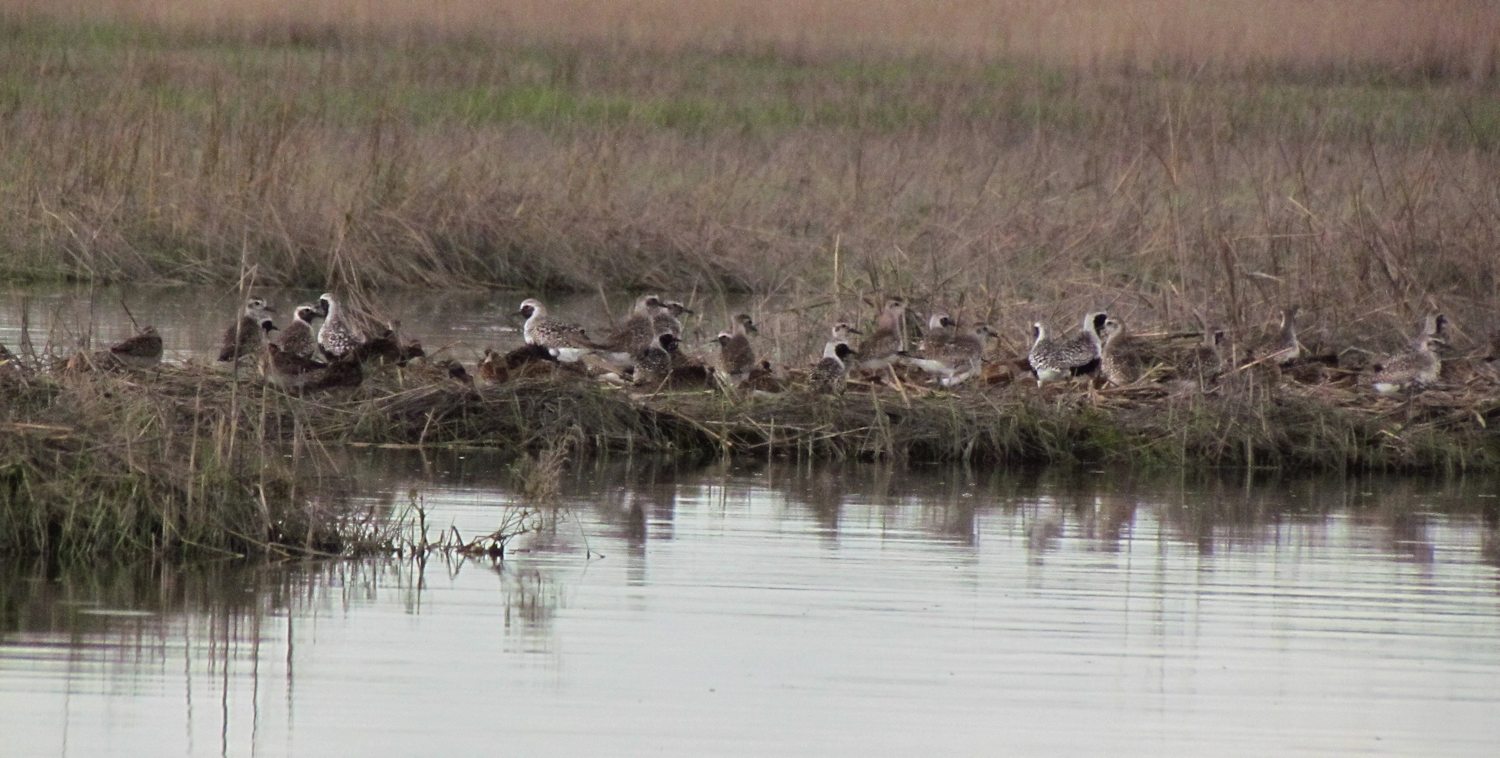
I spotted a black bellied plover, but in short time this took us to a flock of 50+, something I've not seen before.  I figure them to be in migration and if you don't find yourself in the marsh when they are, you don't know.

A swan was still on the first nest that we came upon with two cygnets at her side.  But while I was looking elsewhere, T cried out that they had left the nest.  It is quite likely their first swim as most waterfowl leave the nest for good as soon as they can.  Once in the water they were well protected by both of the adults.  Then, it started dumping rain.
Before
After
The rain pauses.  The rain starts again.  Thunder rumbles in the distance, but not often and only at a distance.  The marsh is not good for lightning storms.

As we continued clockwise around the marsh we started spotting yellow-crowned night herons.  I just spotted my first of the season yesterday, so to find 8 or 10 on this trip was a bit of a surprise.  Up in the Beaver Creek area we came across a flock of 50 glossy ibises.  I've seen them in this spot before, but they disappear to their nests sometime soon and then I don't see them for the rest of the summer.
yellow crowned night heron
We cut once more diagonally across the marsh, a possibility only at high tide, and back to the point where we spot some dunlin, sandpipers, and a pair of oyster catchers.


Monday, May 23, 2016

The Calm of Mid-day

...the wonderful thought that everyplace that you've gone and everything that you've experienced and felt with your heart remains within you flowing through your veins, modifying the signals of your nerves and altering your brain to continue to seek out and add more wonder to what you've experienced.
osprey
It is a quiet day, warm and sunny with a soft wind...and it is not a light wind, but a "soft" wind.  The animal life is somewhat still.  The osprey are out and obvious, but osprey do not have much leaning toward seclusion.  I expect more willets than I see, but I figure them to be back away in the spartina where they are hard to spot.  This trip was timed for a high tide that comes at mid-day, not the best time for wildlife watching.
black bellied plover

One black bellied plover stands out among the birds that I do see, until I spot a shiny yellow fishing lure just beyond the second bridge.  Then, I realize that it has a bird attached to it...in fact, it is not a fishing lure at all, but the pale yellow pate of a yellow crowned night heron.  It is the first one that I've seen this season.
yellow crowned night heron
Just past the stone bridge I start picking up marsh wren calls with fair frequency.  I watch for nests, but with the cattails knee to waist high, there are none.  Until I spot one in the phragmites.  It is a nest from last year however, well weathered but also firmly built and located.  It had to be to last a winter.
with fish (deceased)

With the high tide I paddle into the jungle without only one complaint, a rather loud one, from a resident hawk.


I return the way I came. I spot a second yellow crowned night heron, two more plover and a flying flock of seven glossy ibises.  Things were picking up as the tide began to fall.

Friday, May 20, 2016

Out of Sync

We set out on a falling tide with not much time to dally.  Anyone who has gone hiking or mountain biking with me knows of my early starts and early finishes.  It's about being in sync with nature and cutting one some slack for mistakes that will happen, given enough time.

We put in on the east side of the marsh.  The heads of a couple of glossy ibises can be seen in the distance above the spartina grass.  But for this trip, our heads will be down below that level.  The tide is falling and we have something less than 2 hours to get out and return.  Any longer than that and we will be sitting in a mud flat waiting for the water to rise again.  I don't really like doing it this way.


With the shallow sloped mud flats partially exposed under the vertical bank that spartina forms, we are seeing a great number of shore birds, especially the tiny least sandpipers, but also dunlin and one black bellied plover.  We try the diagonal cut through the marsh, but the water has already dropped to low for the passage to go.  So, we take the usual route out to the point, where we don't find much.  Then, we head upstream through the deep main channel inside of Nell's Island spotting a good number of small shore birds along the way.

The last stretch returning to the put-in is shallow but our timing has been good and we still have 6-8 inches of water.  However, as I knew would happen, we have 40 feet of mud to cross to firm land.  I've done this before, so I instruct S on how to lean her weight over the canoe and keep her feet moving while sliding the canoe to land.  Stop your feet for a few seconds and you stick, but as long as everything keeps moving it is easy.  She seems to find this entertaining.


Thursday, May 19, 2016

The Cusp

It is calm enough to watch the overhead birds without lifting my head, watching the reflections as they pass in the water near the canoe.  It is calm enough to identify the birds by reflection.  I spot a heron, the bird itself going unnoticed until I saw the image dancing a few yards in front of the canoe, that image much larger to my eye than the actual bird, which is just a tad short of being a difficult spot.

Heavy overcast holds the day at the cusp where dawn ends.  Even the birds seem subdued as if they cracked an eye at the usual time and thought,"no hurry".  Many of the larger birds that I expect to see don't appear to have yet arrived.

I put in on a rising tide, a tide that is almost mid high.  My eye level is just barely at the top of the spartina, which is green and lush and 8-12 inches high at this point...just enough to hide smaller animals.  It is still cool and the marsh smells of damp and decay as most of the mud is still exposed.
I paddle toward the point at times touching bottom with the tip of the paddle but never running short of water for the canoe.
5 ruddy turnstones and a dunlin

A ruddy turnstone flies by and disappears around the point.  When I get there I find several more, their feathering matching the rocks, oyster shells and sand to near perfection.  A flock of brandts is further up in along the shore in the main channel of the river.  They flush and it turns out to be a flock of 150-200.  They circle wide and return as I leave the area.
43 brandts

I take a clockwise turn all around the marsh, noting what is in place and what seems away.  Then, to extend the trip I take the narrow channel that diagonals back to the point.  In center marsh I spot four glossy ibises, individuals no longer in flock.  My eyes are well above the spartina at this point and I notice that the smell of the marsh has taken on hints of spice and sweetness with decay no longer present. And, back at the point I find that two dozen egrets, both snowy and great, have come in to feed.  For some reason, they have chosen to feed together in an rather small area.  The cusp of dawn has passed.

Tuesday, May 17, 2016

The Industrial Margins

I've neglected the full spectrum of waterway environments and so I head to someplace that has been on my list but too often pushed aside.

I put in in the next town east in the bay that forms New Haven Harbor, such as it is.  Much of it is far too shallow to be a useful harbor, but some large seagoing vessels do come in on the east side.  I follow the west shore in to the mouth of the West River.  I have paddled a higher section of the river and while most people overlook it or joke about it, the upper part is a rather nice creek type paddle bounded by marsh and forest until it finally becomes a cement lined canal.  This lower section is more industrial.  Old warehouses and factories with the usual associated pilings begin the journey. 


Wildlife is scarce but varied, at least as far as birds go.  I spot a couple terns and a couple of egrets right away.  A pair of completely unexpected willets are flushed from the narrowest of spartina grass margins along the bank.  The warehouses yield to old landfill, a scrap metal yard, and a gravel operation.  I spot a green heron.

The river does a couple big meanders where kids from a daycare center all come and wave and scream, "HI"...until I am out of sight.  I spot a swan nest on the bank and I keep an eye out for the usually aggressive mate.  The swan stays on the nest while a newly hatched cygnet peeps from behind her.  (Only after I look close at my photos do I notice a dead cygnet in the nest as well).  Staying on the nest, not all of her eggs have hatched yet.  The mate is at the next bend, wings raised as it threatens a pair of Canada geese.  Other than giving me the stink eye, it ignores me.
tiny cygnet to right
I turn at the Post Road where a set of idiotic tide gates block my passage.  (Since the tide gates don't prevent rising and falling of water levels above the gate, the only purposes that I can think of is to reduce salt water intrusion and speed of the current into what should be a saltwater marsh and prevent passage by canoe).


Back in the bay, I head east a bit on 5-8 mile per hour winds.  I find a large flock of non-migrating brandts and then head out aiming for the long sand point that nearly cuts the harbor in two.  I figure it to be a short mile out.  The winds rise when I get halfway, doubling in strength and slowing progress to an arm breaking crawl.  I quarter the wind to make progress and then turn to the other quarter to drift to the point.  Progress increases dramatically when I get out and tow my canoe along the shore.  But, I add an threatened piping plover and a couple of oyster catchers to my bird sightings.