Sunday, July 31, 2022

In the Big Marsh

Today was another one of those "blow the carbon out" days.  I was busy for two days hanging an art exhibition and other than that the week has been a bit oppressive on the humidity scale. I also had a special request to bake a batch of lemon bars, so while they were in the oven, I loaded my gear for the quick getaway.

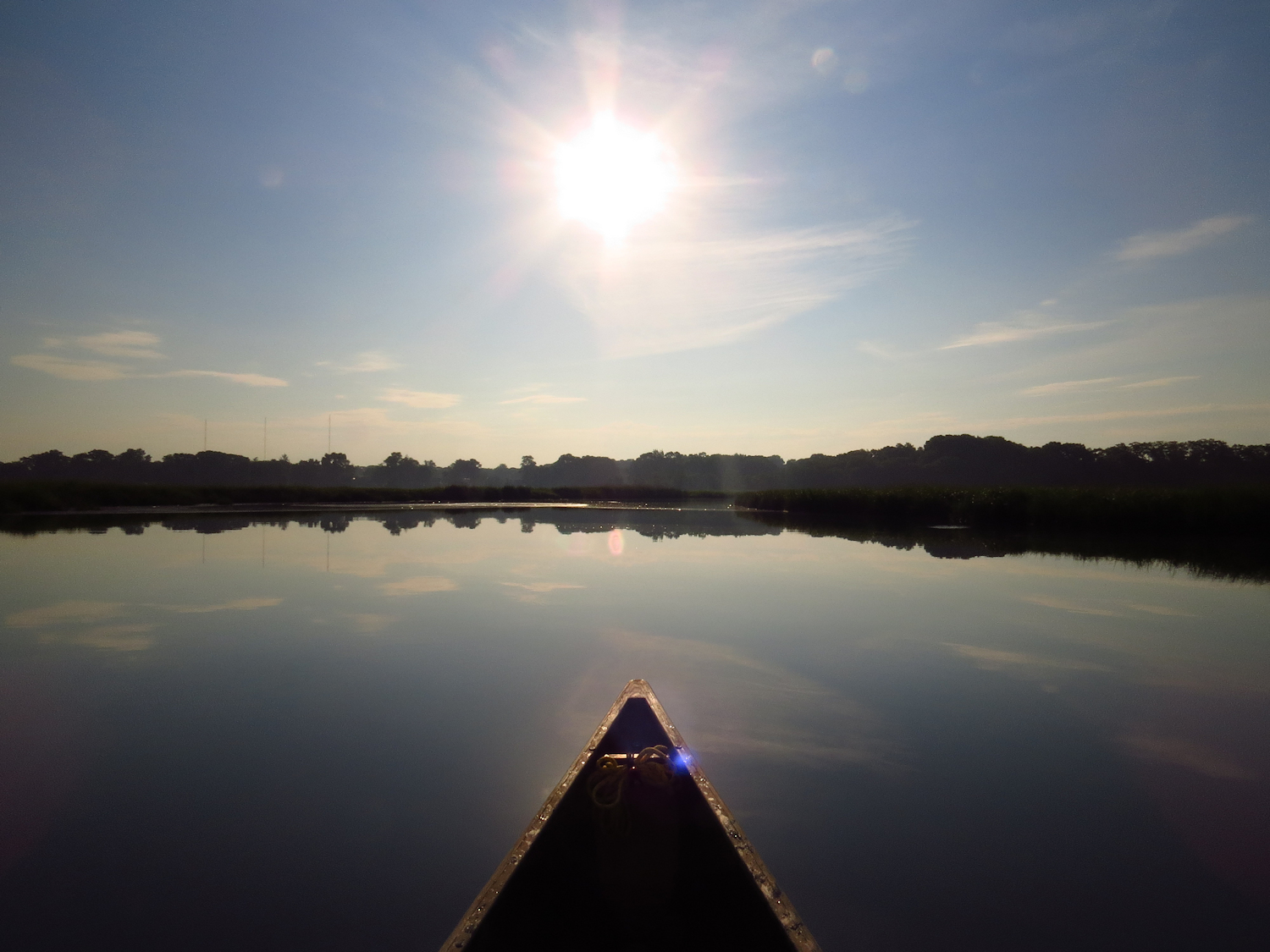
It's a very fine summer day and I put in on the big river for a trip down to the local big marsh. And while there will be a lot of big boat traffic on the river today, I will be where they are not, over by the bank dodging the incoming tidal current.  It takes just about 20 minutes to get to the marsh. I've done it in under 10...all depends on the tides. Those sub 10 minute days kind of get your attention.

Juvenile Yellow Crowned Night Heron

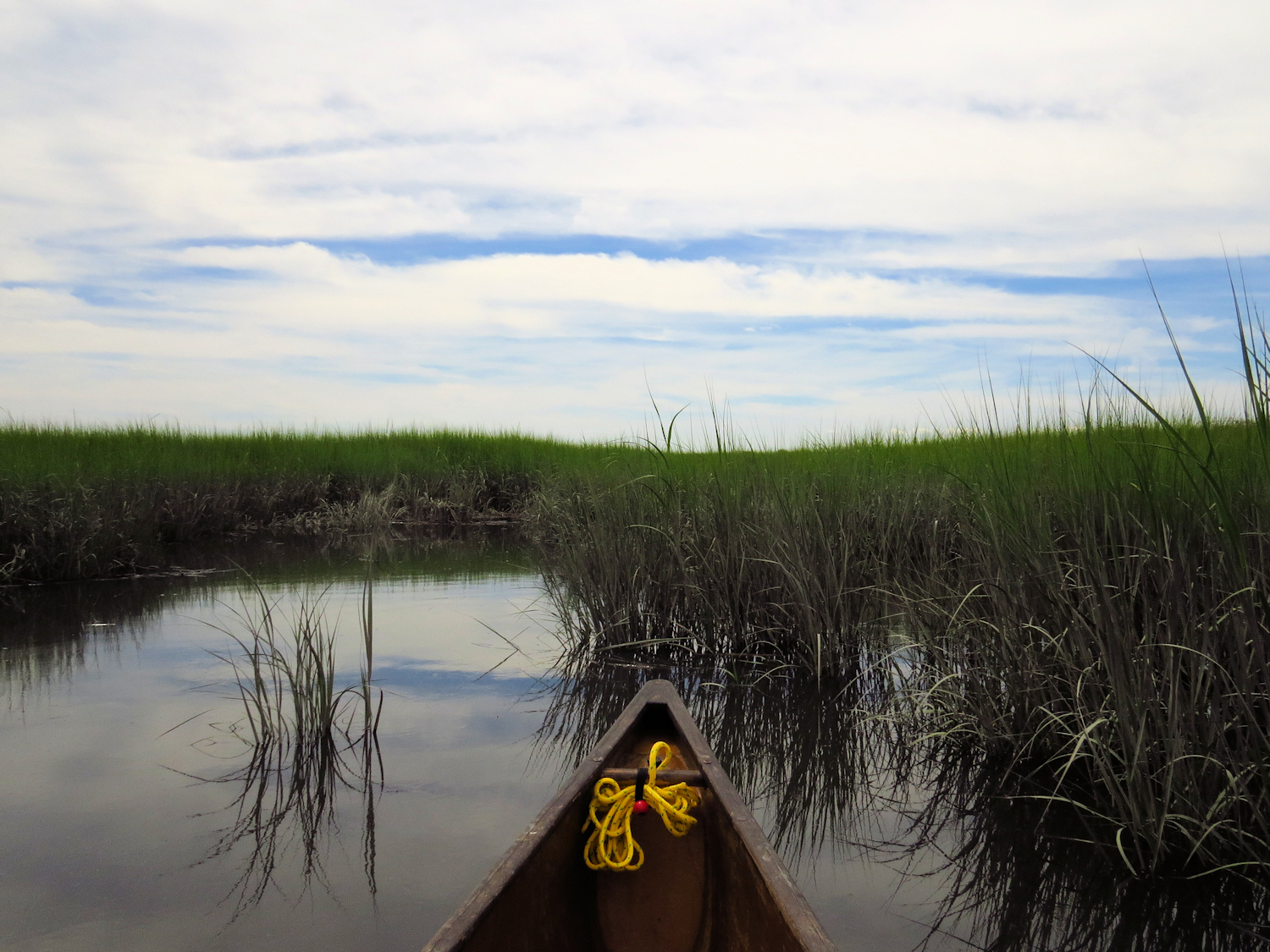
I head into the secret shortcut, which is recently my preferred route.  It meanders, a narrow channel surrounded by tall spartina - the cord grass variety. I can't see far in here, but no one can see me either, and I've never seen anyone, ever, in here.  At the high spot phragmite patch, I flush a half dozen Black-Crowned Night Herons, the most I've seen at one time this year.  Three Night Heron juveniles and a dozen ducks also flush. I suspect that the juvenile Herons are Black-Crowns, but without a good look, it's hard to tell a Black Crown from a Yellow Crown.  From there, I aimlessly wander toward Milford Point.
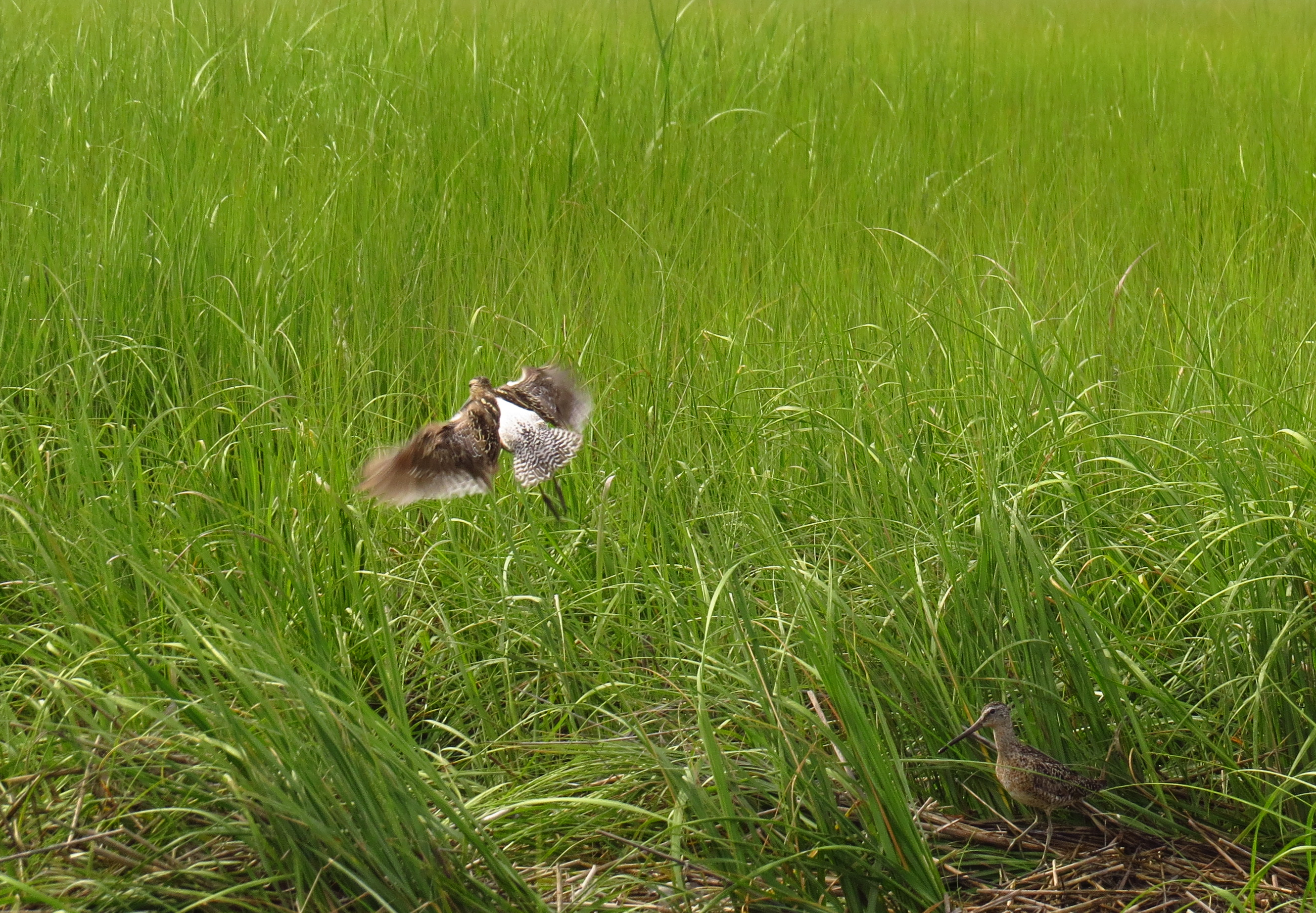
Of note, I have not seen any Short-Billed Dowitchers since the 17th of July, so they must have been on a tear to migrate south. It's interesting behavior that a bird would fly to the Arctic and migrate back as soon as possible, which just can't be long after their young fledge. Anyway, they are known for early migration.  This quick stop over, which they seem to do out of easy viewing in the center of the marsh, might explain why the bird sighting count is so low for Dowitchers. In one day, I saw about 10 times what the shore based bird watchers recorded for the month.

There's a guy fishing at the point, and we both pause to talk. He asks me about the fishing and depth of water, and I tell him that all the fishermen that I've seen out here are on the river side of the point. He admits not knowing what he is doing and not particularly caring as it is so nice out. He passes my "good guy" test.  

I head east around the bottom of the marsh. The inner corner is often a good spot for juvenile Herons, but not today.  I spot a few more Night Herons before sneaking back into the shortcut. I explore one promising side channel, which forks into two dead ends...a bonus.  

I head back up the river along the shore with a tailwind and the last of the flood current.  The boat launch is busy with... well, just say that seamanship is an inverse relationship to horsepower.  I take out on the bank next to the launch and vacate the premises.

Tuesday, July 26, 2022

To Hamburg Cove

Yesterday, a weather front pushed through, dumping some rain with some good booming thunder.  Today responded with a cooler and less humid day that is near perfect for summer paddling.

Young Osprey at Brockway Island
I put in at the North Cove in Essex.  This starting point became more popular with me once I found out about the history.  Much of the cove shoreline was shipyards about 200 years ago.  During the War of 1812, the British ran a successful raid here burning 27 ships and escaping with only two casualties. 

I head across and out into the main river through a narrow and shallow gap in a long marshy bar that divides the cove from the river.  Then, I follow the bank up, past the remnants of the Ely Ferry landing.  There are many Osprey.  In the cove, I spot seven flying with two fledglings on a nest.  At the point near Brockway Island, two more are perched with a few more flying in the area.  There are small schools of Menhaden along the shore, and tell-tale splashes of more menhaden farther out in the river show that the Osprey are eating well.  Menhaden is a herring type fish that is staging a strong comeback in this area due to sensible fishing laws.

I cross over to the downstream end of Brockway Island and then continue over to the mouth of Hamburg Cove.  One of the historic Ely houses is sporting a 6x8 foot electric sign showing that the owner is a complete political dickweasel...no more on that.

The cove is very quiet today with the only moving boats being a marina work boat and the floating menagerie from a shoreline summer camp.  Lots of Great Blue Herons, some Great Egrets and, of course, more Osprey.

Falls Brook

I head up Eight Mile River until running out of water, which is not much more than a half mile.  My thoughts on wading farther up are tossed aside as there isn't enough water to float an empty canoe over the shallows.

On the way back out, I side trip up Falls Brook.  It's just short of a half mile in until you run into a couple of beaver dams built onto two small road bridges.  I've been here before and judged the work required to get around the dams too difficult for the amount of water upstream, which might not be enough for a canoe.

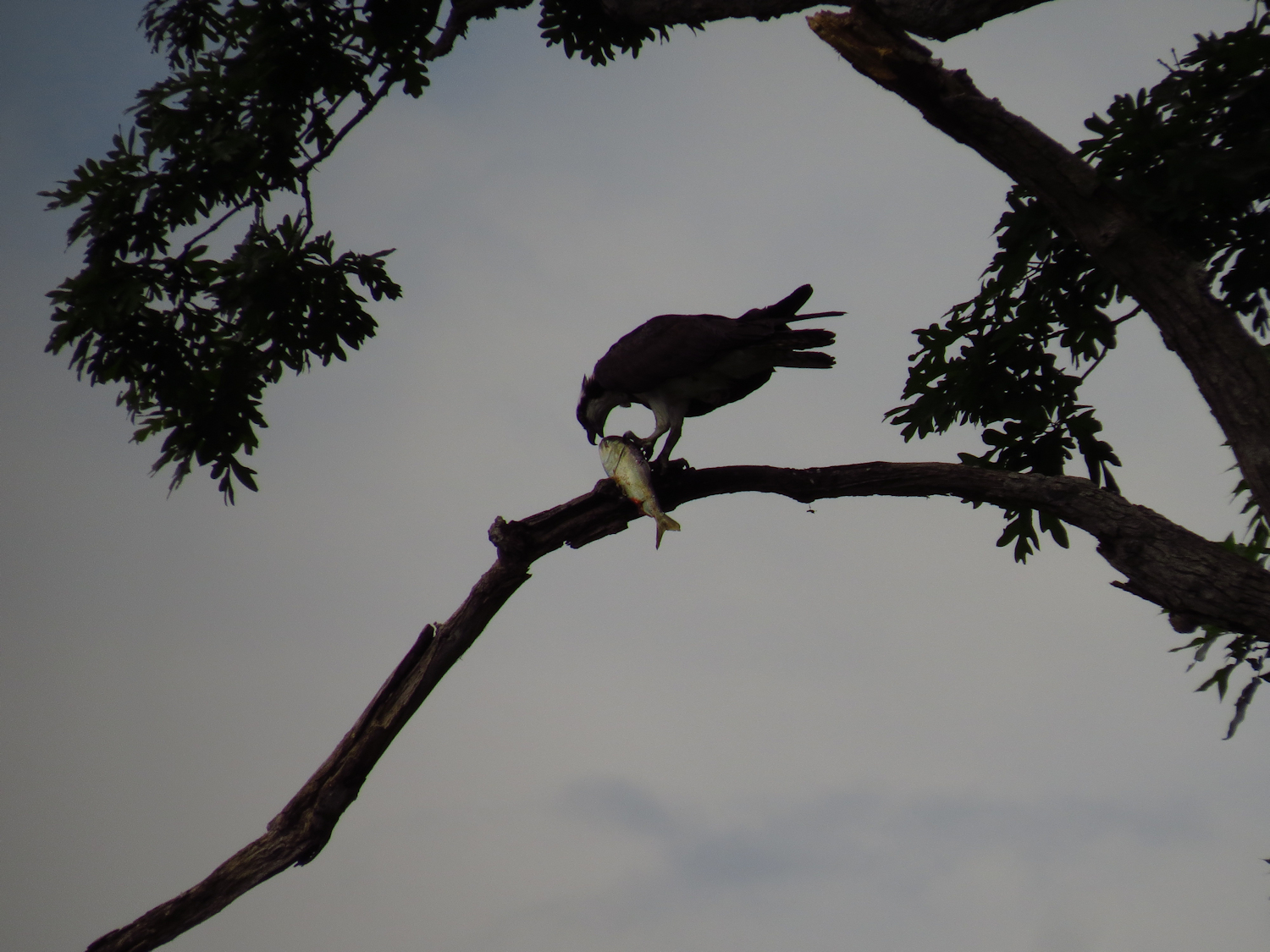
Heading out, an Osprey overflies me and perches with a large and still alive menhaden in its talons. At the mouth of the cove on the west shore, 3 Great Blue Herons, 2 Great Egrets and 2 Osprey all perched in about a hundred yard space.

I recross the river at Brockway, and return just as I had come.

Friday, July 22, 2022

Tides and Such

Another hot day.  If I was on a canoe trip, I'd be up and paddling before dawn and then napping during the afternoon heat.  As it is, this is another short day trip as I work over the waters that are closest to our house.  There's not much sense in an hour drive to get in a 2 hour paddle.

I head down to the Wheeler Marsh again.Today, the tide is a bit more interesting than normal.  If you're not familiar with tides, you basically have two cycles per day ie, low, high, low and high.  The timing between a low and high is a usually somewhere between six and a quarter and six and a half hours.  So, the next day's lows and highs will be about one hour later than today.  Besides the timing, tides also vary in height depending on the moon. Here, a maximum high tide is 8.5 feet with the minimum low tide being -1.3 ft. This morning's high tide is only 6 feet with a low tide of -.7 feet and this has a couple of effects.  One, the slack tide at the high or low (slack meaning little current) lasts longer.  And two, the tidal currents, which are highest halfway between low and high tides, are less.  On top of that, tides are affected by geography such as constrictions in the river or in this case, a big marsh crisscrossed by dozens of channels.

I get down to the marsh in about fifteen minutes on a very light current - not so much a tide current as it is the natural river current.  The water in the marsh is not flowing at all, it is dead still.  I head up into the secret shortcut and then meander through the middle.  It is surprisingly quiet as far as birds go.  I spot a couple Yellow-Crowned Night Herons, a couple Great Egrets, just one flock of Sandpipers and a few Osprey, which are hard to miss as they are perched on their nests. When I get up near Milford Point, I head counter clockwise around the outer edge of the marsh.  Spot a shaggy white tail deer fawn at the Refuge launch.  Now, an hour after high tide, the current is barely noticeable and then only by checking the lean of submerged swamp grass.  As to tides and marshes, they don't drain upriver/downriver.  Marshes are reservoirs and they fill and drain by a rule of least resistance... the water direction is in or out of the marsh by the easiest path, which may not be what the open water of the river is doing.  It's not that big of a deal, unless you are trying to navigate by reading the current... or you run out of water before finding your way out.

As I leave the marsh and head back upriver, it seems that the Herons have arrived for breakfast.  I spot a dozen Yellow-Crowned Night Herons in the last 200 yards.  One is a juvenile.

Thursday, July 21, 2022

Downtown

It's going to be another 90 degree day, although later there is a chance of thunderstorms.  It's a tough day to do a long trip when it is 90 degrees and you're sitting on a big solar mirror.  

I put-in at my town's small harbor.  It's quite packed with parked pleasure boats at this time of year.  It makes me wonder where so many boats can be stored during the winter when they are hauled out.  I'm in the water just after seven, and just after high tide, and no one else is driving their boats, yet.

I head out to the mouth of the harbor and then up into Gulf Pond.  The pond doesn't have the bird life or diversity of the Wheeler Marsh, but their are a few pairs of nesting Osprey and always some Egrets that come in to feed.  If I was them, I would prefer the Wheeler as well, being larger and providing more cover and distance from predators.  The pond is split in two by a long cause way and bridge with the upper half narrower with a wider buffer of spartina marsh.  Then, under a low road bridge and through the old railroad bridge.  The rail bridge is probably a 19th century relic from a time when people didn't think twice about constricting water flow.  Narrow as it is, bad timing with the tide can keep you stuck on one side or the other for a couple hours. It also turns into a pile of jagged boulders at low tide.

The section immediately above the rail bridge is the Indian River.  While none of this trip is particularly wild, this is the best of it with a wide buffer of spartina and few houses in sight.  It's a good place to spot Herons and Egrets and I spotted my first two Bitterns in here.  

Far enough, long enough, I turn back.

Wednesday, July 20, 2022

Beat the Heat

I head out earlier than normal and I'm on my way downstream by a quarter after seven.  This week is going to be all 90 degree days, sun and high humidity.  It's tough weather unless one has a narrow shaded creek to paddle in,

The tide peaked just over an hour ago and already I have a good current to carry me down. I'm in the marsh in no time.  I head clockwise around the outer edge, spot five Yellow-Crowned Night Herons right away, spot two immature Night Herons a bit farther in, and spot the white Cygnet with one of its parents. Lots of small sandpiper flocks working the freshly exposed mud.

The marsh smells of green growth mixed with the warm vapor of brackish water.  

I go a ways into the middle, spot six Short Billed Dowitchers, and eventually misplace the passable channels and head back the way I came.  Then I pick up Nell's Channel and follow it upstream.  

As I am leaving the marsh, the Osprey have gotten up and are soaring and whistling.

I eddy hop the east shore making the paddle against the current fairly easy.

Monday, July 18, 2022

Housatonic 2

Today, I was hoping for a short trip in the rain, and while the rain certainly came, and at times as a downpour, there was also an unbroken rumble of thunder right up to noon. Although there was no visible lightning, it was not good weather to be out in open water.

With a let-up in the afternoon, I headed out for a quick trip.  I went upriver above the first dam, where the river is enclosed in a forested valley that would give me a little cover in case another thunderstorm passed over.

I started at the Boy Scout put-in and headed upstream.  The water was down some and there was barely any current.  The small rapids a third of a mile below the dam are usually class I in summer conditions.  Today, they were more like class 0 and I only had to paddle hard at through one ten yard stretch.  Spotted one Eaglet on the nest below the dam and about 2 dozen young mallards.  I turned back from the portage trail.

About halfway back, I started to hear distant thunder behind me to the north.  The sky farther south was quite dark.  As on the way up, I hugged the shore, staying under the tall green leafy lightning rods. I started to get some scattered sprinkles and the thunder was closing as I finished.  Just as I shouldered the canoe, I saw the first sign of lightning, a dim flash on the ground under the canoe.

Sunday, July 17, 2022

Dowitchers Already?

It was time for a break.  I'd been sewing all day and my fingertips were sore with needle punches and my back needed some loosening up.  I headed over to the Wheeler Marsh just as the tide peaked.  To make the trip quick, I put in at the Wildlife Refuge launch,

The weather was 80 degrees with a sunny haze and light wind.  


Two Short Billed Dowitchers
I headed into the secret shortcut but turned down river instead of following the usual path up.  This took me close to the central marsh high ground, a patch of phragmite reeds that probably survives because it is six inches higher than the rest of the area.  Immediately, I flushed a Black Crowned Night Heron and a few Yellow Crowned Night Herons, some Mallards, and a few Willets.  But as I meander through the tighter channels heading down the marsh, it gets better.  I flush several more Willets, more than I normally see in the Wheeler.  Then I flush thirty medium sized Sandpipers.  Four Willets join in with them as they fly a formed flock.  They stay airborne for over five minutes, circling and crossing the central marsh a few times before settling.  As I continue, I flush more of the Sandpipers, usually in groups of 6 to 10.  They're very hard to identify as they disappear into the spartina when they land.  I finally get a blurry photo showing a straight to slightly upturned bill.  Then, I get lucky and finally get a good flight photo.  They are Short-Billed Dowitchers.  This is migration territory for them with nesting grounds near Hudson Bay, Saskatchewan, Alberta and the Pacific Coast in the same latitudes, and winter grounds on coasts south of here as far down as South America.  I read up and learned that Short-Billed Dowitchers are early migrators...so, here they are.  Of note, the "pro" bird watchers haven't counted this many of them in recent days. That may be because they are counting from land and I am only spotting the dowitchers by flushing them...and I am several hundred yards from shore.
Juvenile Yellow Crowned Night Heron

I also spot a juvenile Yellow-Crowned Night Heron...just one of those.

I finish up by circling up and through narrower interior channels before.