Sunday, December 18, 2022

The Weather Eases Up

Wind, rain, and general busy-ness on the days that weren't windy or rainy has kept me off the water for over two weeks. Today came with light wind, a mix of sun and clouds, and temperatures near 40F. I thermos'd the last of the coffee and headed out, a little bit later than I should, but with plenty of time for a good trip.

Fresh tree gnawing, fortified lodge, and winter food stash
I put in at the usual spot on the Mattabesset. The guy with the outrigger canoe was just taking out as I was starting. He lives nearby and paddles even more than I do. He also paddles about twice as far as I do, which is not just because of his faster canoe. He tells me the wind and water levels are good. He'll be the only person that I see.

The water is obviously high. Low tide should be in another hour, but the water is still just a few inches below the top of the bank. A storm rolled through a couple days ago with a good amount of rain. When the Mattabesset is high, it's because the Connecticut is high. But, since the current is faster than normal, I gather that the Mattabesset has collected a fair bit of runoff. It is an easy paddle downriver.

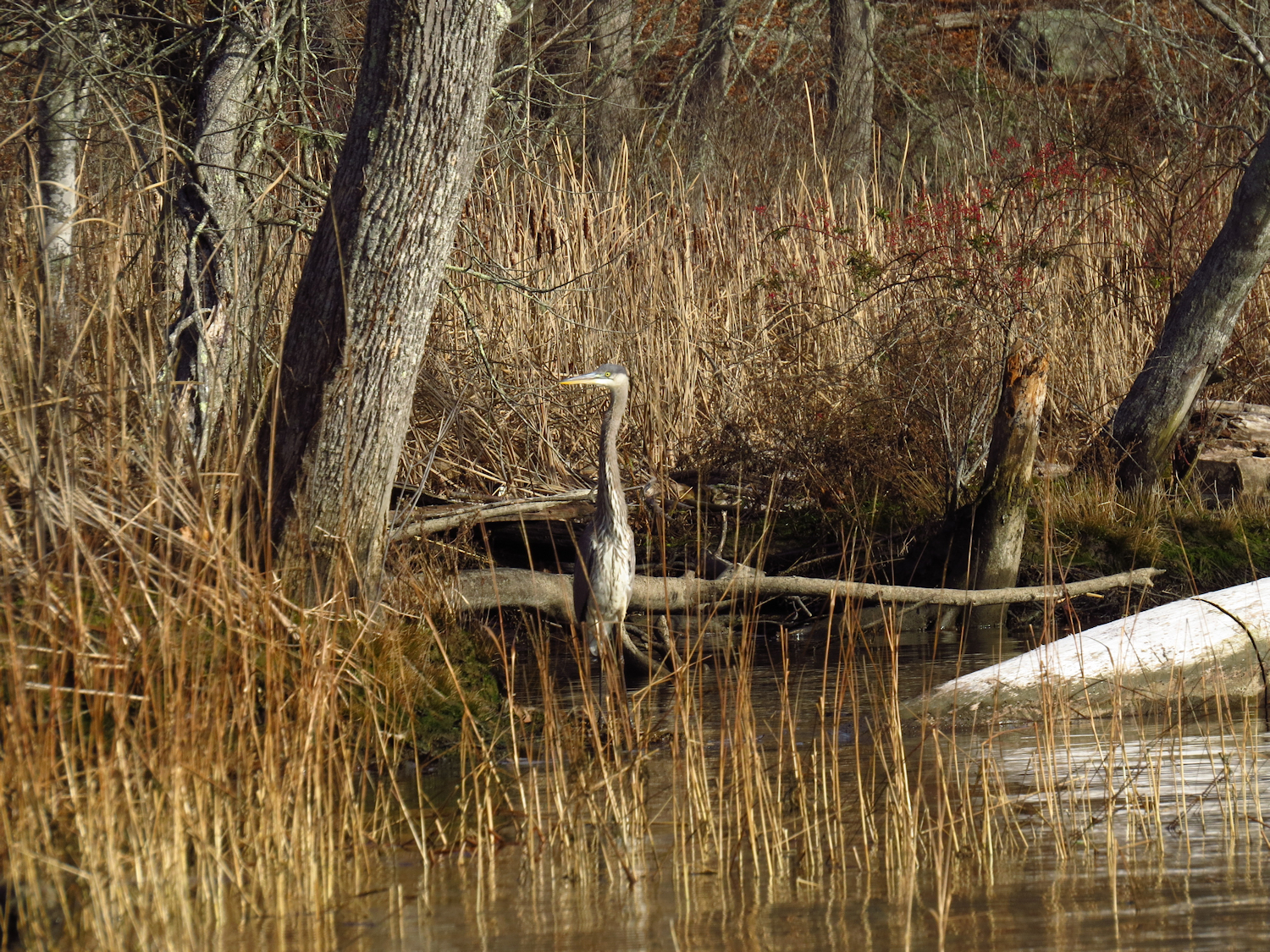
I spot a few Great Blue Herons on the way down. There is a lot of fresh beaver activity - gnawings, partially cut trees, lodges fortified, some with a winter stash of saplings. There aren't more beaver, it is just that the summer foods have gone dormant and the best nutrition is the inner bark of trees. I keep my eyes peeled as this is just the kind of day where a beaver might sun itself on the bank.

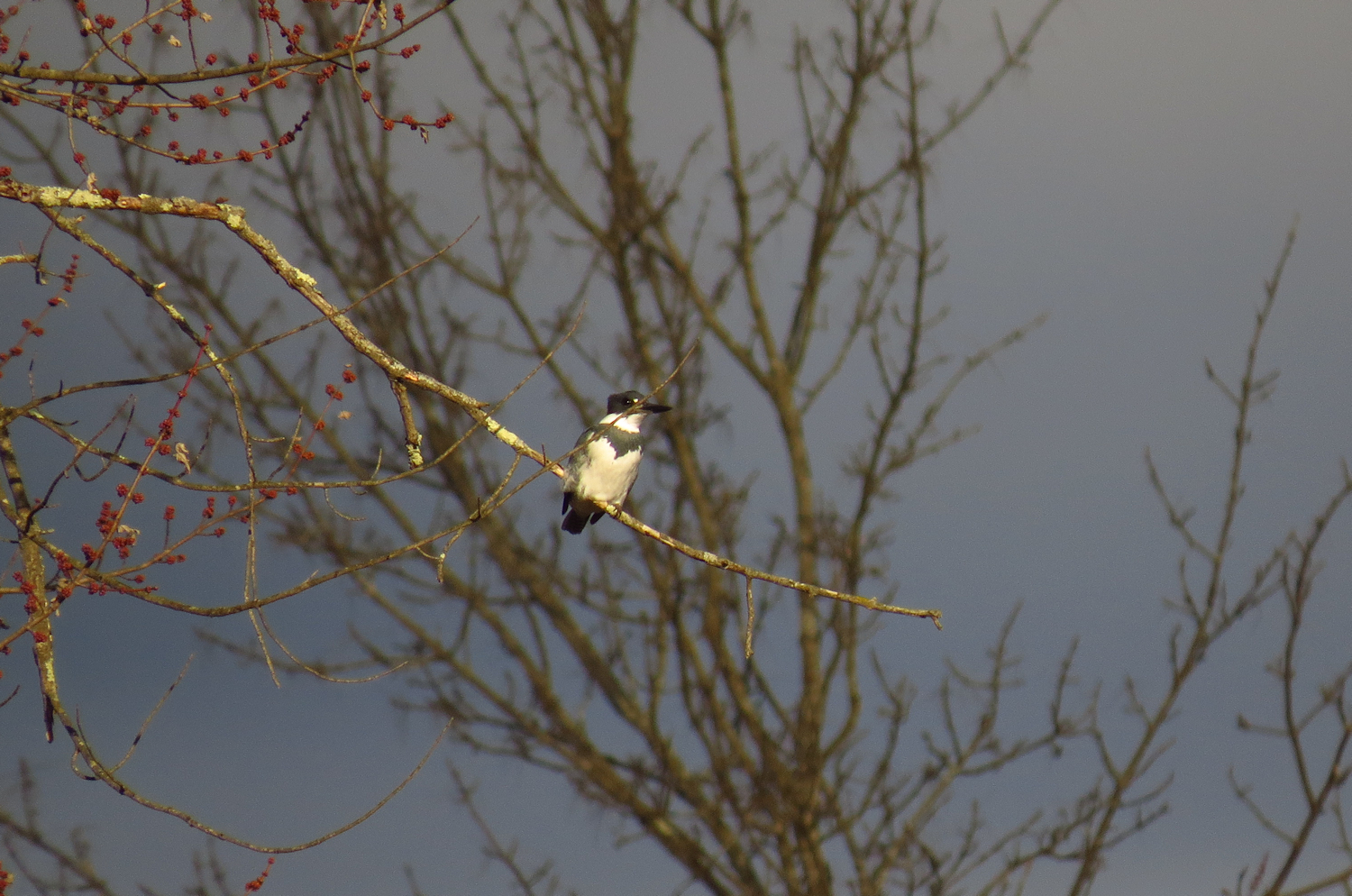
I spot several Belted Kingfishers. By the end of the trip I figure this to be the most numerous sighting of the day. 
When I get the Connecticut, I turn upriver for a mile or so. The current is nothing unusual. 

On my way back, I spot two white tail deer near the mouth of the Coginchaug. They were quite a ways off and I only noticed them because the were running. I spot four Hawks over a couple of miles. Due to the light and/or distance I cannot identify any of them other than to say that they were all different species. I see several more Kingfishers and a couple Great Blue Herons, and while I am doing my bird math, a nearby Pileated Woodpecker lets me know that it is there.


Friday, December 2, 2022

Checking on the Runes

The other day, I pulled my copy of Sigurd Olson's book, "Runes of the North," off the shelf, and it is damned near impossible to avoid going out in the canoe after reading a couple of those essays.

I took my time this morning and finally got moving with an hour or so of falling tide remaining. But, the weather service is spot on with a light south wind, sun, and temperature climbing from the mid 30's to the mid 40's. I put in under the highway and head down river to the big marsh. A few oyster boats are working this part of the river as are a few sport fishermen.

Entering the marsh, I spot a half dozen Buffleheads, the first that I've seen from the canoe this fall. They prefer bays and estuaries near the salt water during winter. 


Beaver Creek
I find a bottle sticking out of a partially slumped bank in the long bend upstream of Cat Island. I retrieve it for dating when I get home (Later: It is a Knox Bottle Company #4 dated 1932-1968). My lazy start has limited my choices. Just past Cat Island is the critical point for a low tide paddle in the marsh. I'm down to about 4 or 5 of water with 200 yards to go before it gets deeper. There's no walking out of this tidal marsh - you pretty much would go in up to your waist in the muddy bottom if you tried, so I turn back.  If I'd started a half hour earlier, I would have cleared the shallows, easily.

I take the side trip up Beaver Creek, which is a favorite wintering spot for a variety of birds. Right off, I flush a dozen Mallards. After that, it is all Black Ducks - about two dozen of them, plus a Red Tail Hawk. In the past, I've spotted Bitterns up in here and there always seems to be a Hawk or two watching from the trees. I turn back about halfway in when the creek is just barely wide enough to spin the canoe.

Dunlin

Before paddling back to my put-in, I park for a few minutes in the top of Nell's Channel. There is a flock of fifteen Dunlin speeding up and down the channel, stopping once in a while to feed for a few minutes before zipping off again. I manage to get a few photos the second time they get to this end of the channel.

Tuesday, November 29, 2022

Huldre

It dipped below freezing last night, which took some of the oomph out of my early start ideas. No matter, it is a calm and sunny day and it reaches 40F by the time I set out from Ely's Ferry. I chose this start point to cut out a short hour of paddling so that I could spend time sitting, when I got to a place that called for it.

I paddle along the shore, staying out just far enough to be in the warmth of the sun. I flush a couple dozen Canada Geese at the mouth of Hamburg Cove. Up ahead are a few shoreline houses, one of which is quite a bit older than the others. It is also architecturally more interesting. I recently noticed that the road they are on is Brockway Ferry Road. At first, it seems odd that only two miles upstream from Ely Ferry there should be another. But of course, ferry traffic is actually "road" traffic, and the land distance between Brockway Ferry and Ely Ferry is, by wagon, a hilly half day trip as one has to get around Hamburg Cove. The Chester-Hadlyme Ferry, which still runs, is another two or three miles upstream from Brockway. It would also be a hilly half day trip from Brockway. (Later note: The Brockway Ferry started in 1723. It shut down around 1800 as the shipbuilding industry in Essex was growing. The Ely Ferry began operations at that time being more convenient to Essex. The Chester-Hadlyme Ferry began in 1769 and still runs from April to October)

There is a Bald Eagle perched about 200 yards upstream of the entrance to Selden Channel. I flush a Great Blue Heron just inside the channel.

I find three stone blocks on the shore at water level. They are about 3x6x10 inches, skillfully and neatly shaped. Where they are is backed by a hundred yards of cattail marsh, so where they came from and why is a mystery. All I can say is that they are out of place.

Instead of paddling the length of the channel, I turn up the creek that comes out of the Elf Forest. It is very quiet, although not silent, which is a rare occurrence in modern life. But, the noise is limited to a low muffled rumble from a highway that is a few miles distant. It is a reasonable facsimile of silence. I pour a cup of coffee. There is a rooster somewhere on the other side of the Elf Forest.

I have a sculpture in a show in New Haven. I call it "Huldre", not so much a title as an identification of a creature. The Huldre is a female of the hidden people of Scandinavian folklore. Her method is to appear as beautiful woman and lure men away into captivity... the folklore explanation of how an able woodsman should seemingly disappear without a trace. My huldre is far more haunting - what I imagine her to look like when among her own people. It is made out of stuff that I have found while canoeing. At the show's opening, two little girls were particularly intrigued by the huldre and they asked the good questions. Kids always ask the good questions. 

They asked me, "Have you ever seen a huldre?"  I Say that I have not, but I have heard the huldre. Later, I got to thinking about when a person might see the huldre. First of course, the huldre is a creature of wild places. With that, my theory is that one can see the huldre when they are either lost and completely terrified (which is when you really, really don't want to see the huldre), or when they are completely at one with where they are, in which case the huldre poses no threat. Of course, the huldre is something deep inside of us, and you want that stuff to surface only when you are ready for it. So there.

I begin my way back, detouring up into a small opening that I have passed by dozens of times. It goes farther than I expected.

I return as I came with one brief stop to stretch my legs.


Saturday, November 26, 2022

Flashbacks

I get a late start on a fine day, setting out from under the highway bridge and heading upstream, which was a snap decision driven by the last bit of flood current, which would be in my favor, and a northwest wind that I could hide from on the way out, and make use of on the return by paddling opposite sides of the river. The boat launch was near full and so the fishing must be particularly good right now.

Peacock Island to the left, and Carting Island to the right. This is intuitively obvious.
I cross the river, weaving through the bridge abutments, and head up the outer channel until turning into the gap between Peacock and Carting Islands. I take a photo and amuse myself, "Carting is on the right, but that is intuitively obvious." This is an oddball flashback to the weed-out calculus courses that everyone had to endure in the first year of engineering school. Some calculus freak with a personality defect would be lecturing at the board, writing out an equation that included logarithms, PI, some variables raised to various powers, and some weird trigonometric function. The freak would then go through a dozen mathematical gymnastic contortions supposedly simplifying the gobbledeegook while solving for the integral until, with several steps left to complete, he would announce, as if it was a death sentence, "...and it is intuitively obvious that the answer is 6." Nothing was ever intuitively obvious and the last few steps would forever be a mystery. Sometimes, this is what goes through my head when I am canoeing.

I spot a Hawk far off. It moves to a perch in the trees where I cannot identify it. Then, by total chance, I catch it with the camera in mid flight. It could be a Red-Shouldered, but I think it more likely to be a Red-Tailed Hawk. I flush 29 Black Ducks from Carting Island. I spot a pair of Teal and a flush a pair of Wood Ducks near the top of the island.

From the four islands, I follow the west shore. I pass Peck's Mill, or at least where Peck's Mill was. I did some research on it this week and found pretty much nothing, except for a early 20th century newspaper article about a street car accident where several people were killed when the street car derailed off of a thirty foot tall trestle. 

I make good time to the dragonfly factory and head in to look over a creek that enters the river. 

With the late start, it is now time to head back. I cross the river, picking up a light tailwind as well as a slight ebb current. I flush four Woodies (Wood Ducks). There are still quite a few fishermen out.

Wednesday, November 23, 2022

A Ruddy Duck Day

A week or so of art related activities and several days of high winds has kept me off of my usual routine. Now, the month dame in with a week of  atypical 70 F days, which was adjusted for by waking up to find the backyard bird bath frozen solid... kind of a shock to the system.

Today arrived as predicted by the weather service - 50F, fairly calm, and sunny. I headed inland to the Mattabesset, a relatively small and protected river bounded by large marshes and entering the Connecticut River just upstream of Middletown. 

Son o' Tepee Lodge
Yesterday, I put a new neck gasket in my drysuit, a fiddly, twitchy job with glue and and homemade templates. Today was the test drive. A drysuit is a waterproof full body garment. With mine, only the head and hands are exposed, with the neck and wrist sealed off by tight latex gaskets. After a few paddle strokes, I performed the scientific finger dip test - the water couldn't be much warmer than the mid 40's. 

As I paddle down river, I can see small eddies on the upstream side of branches in the water. Even fifteen miles from the ocean, the flood tide has reversed the river current. High tide at the sound was bout twenty minutes ago, but the distance means the tide will keep rising here for another hour or more. A rim of ice on the bank from last night shows that there is about six inches of water still to come. I spot a couple Kingfishers while still in the forest, and flush a Great Blue Heron just as I get to the first marsh.

A couple shotgun reports signal a hunter deep in the big marsh, well away from the river. It looks like thin hunting to me as I haven't seen a Duck, yet. 

Ruddy Ducks in winter colors

The Son o' Tepee beaver lodge is in good condition and has been recently fortified for the winter with a fresh coat of mud. Its predecessor, the Tepee lodge is abandoned and continuing to collapse. It is less than a canoe length from one lodge to the other. I spot four Ruddy Ducks, an unusual sighting for me as we are at the northern end of their wintering range.  Farther away, at the point near the mouth of the Coginchaug, a Bald Eagle is perched, until I get my camera ready.

Bald Eagle

I turn up the Coginchaug. This small river has a good population of beaver. Right away, I spot several small scent mounds and as soon as I get near the trees, I see some fresh gnawings. The first lodge, which rivals the pyramids of Egypt in size, is looking good  and recently fortified. I spot a Pileated Woodpecker just upstream of the railroad bridge. Its squeak toy call tipped me off. It is busy flying short hops from tree to tree looking for food. It does not seem perturbed by my presence. A bit further up, I get scolded by a Red Tail Hawk. It flies to another perch and watches me, until I start to raise my camera. Then, it flies off.

I turn back at the power line crossing knowing that I will have log jams to crawl over just around the next bend. On the paddle back, I spot a Harrier working the big marsh. I love watching them skim the tops of the marsh plants hunting by stealth. I pass a kayaker paddling in, and meet a speed demon with an outrigger at the takeout. They're all old geezers like myself - and that is not an unusual sighting for this river.

Wednesday, November 2, 2022

Up to Great Flat and Back

 I set out, finding the ebb current quite a bit stronger than I expected. Combined with that was a down river wind, which also was quite a bit stronger than expected. I crossed the river right off using the eddies behind the bridge abutments to make easier upstream progress. Once above the bridges, I crabbed to the far bank holding about a 45 degree angle to the river flow. Still, it is a very nice autumn day.

I headed up behind the four islands, as I often do. This side of the river is salt marsh islands and maintains some state of wildness. The east side of the river is a retired coal power plant. I look forward to seeing that plant removed and replaced with some natural vegetation - someday.

It is most definitely a grind up river today. The wind is a good deal more than the weather prediction and as I cross from the tip of Long Island to Pope's Flat, I am already deciding to cut this trip short. However, the east shore provides better cover from the wind and the going improves.

I spot two wood beams and what looks like the remains of a stone wall in the cut bank right below the electrical towers on the east bank. They are almost three feet down from the surface and the marsh soil above them looks undisturbed. I have no idea what might have been here, and since the soil above the features appears to have naturally collected, it might be worth some research. That amount of soil hints at something pretty old. Peck's Mill stood directly across the river from this spot. Peck's was noted on an old map as there are no obvious remnants.

The beams are approximately 3x8 inches.

I turn when I am just below Great Flat (the 6th island from the sea). There is no hiding from the wind for the next mile or so. It has taken over an hour to get here today, nearly double the normal time. It is, however, an easy return.  The wind dies to almost nothing when I am about a quarter mile from my take out. Timing is everything.

Monday, October 31, 2022

Godwit Sighting

I head out just an hour past low tide and the incoming current hasn't caught up with the river's natural gravity fed flow, until I am below the bridges. Three oyster boats are working the river in the mile between the launch and the top of the marsh. Forty percent of oyster seed in Long Island Sound comes out of this river, which to me, is an unusually high number given the number of rivers and estuaries feeding the sound. Housatonic oyster boats are restricted to hand winching their drags to help preserve the fishery.

The day is warm with a high thin layer of partial clouds that lets plenty of sun through. The wind is light and coming upriver.

Hudsonian Godwit

The first bird sighting is a Great Blue Heron at the top of the marsh, The second birdis spotted just as I head down Nell's Channel. It is one that I am unfamiliar with, or at least, something I don't remember. I look it up when I get home. It is a juvenile Hudsonian Godwit migrating through. About the size of a Willet, the long upturned bill and a very obvious white butt patch make the book identification easy. This bird is on its way from Hudson Bay or the Arctic coast to Argentina, a decent commute for sure.

With the low water, I have the channel to myself. The upper end of Nell's Channel is shallow and if there is enough of a deep channel for a motorboat to squeeze through, few motorboaters would know about it. I paddle along the cut bank of the east side looking for stuff sticking out of the mud. A perfect cylinder two feet down draws me over. It is wood with the end squarely cut off - something like a broom handle. There's no way to date something like that without a lab, so I leave it. Next, is a 4x5 inch beam with a wood peg in it. It could be part of a house, shed, barn, boat, bridge, etc. Other than being old, there's nothing else to tell what it came from. Then, 20 inches or so down, a long rubber seal. It is old rubber - the old stuff, which is more rubber and less plastic, gets gooey and lifelike. Newer stuff tends to crumble, if it breaks down at all.

Beam with a wood peg

I spot two Harriers, one ahead of me and one behind. They are both busy hunting. I spot a few more Great Blue Herons and just one Great Egret. Of note, I see zero Night Herons.  There are quite a few Yellow-Legs working the low tide mud flats in the lower and central areas of the marsh.

By the time I am done poking around, I can manage the counter-clockwise circuit of the marsh and then make my way back up river on a good flood current.