Friday, August 3, 2018

Bird Shift


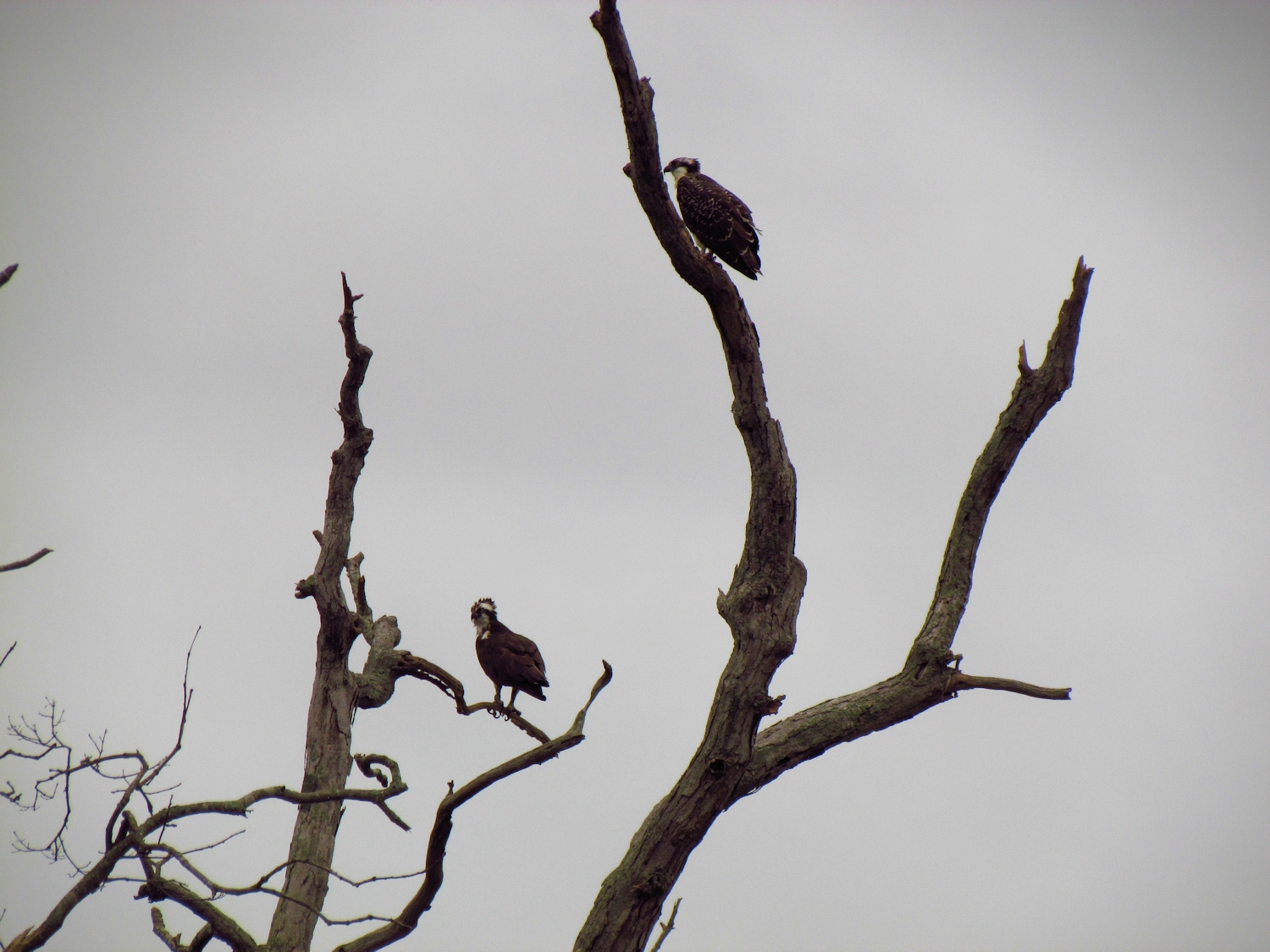
I head up the East River near the bottom of the tide, getting an early start in order to beat the coming heat of the day.  The Osprey are not accommodating my desire of watching them fly.  The young are still not overly excited about testing their new skills and the adults are staying close to the nest where they can keep an eye on things.
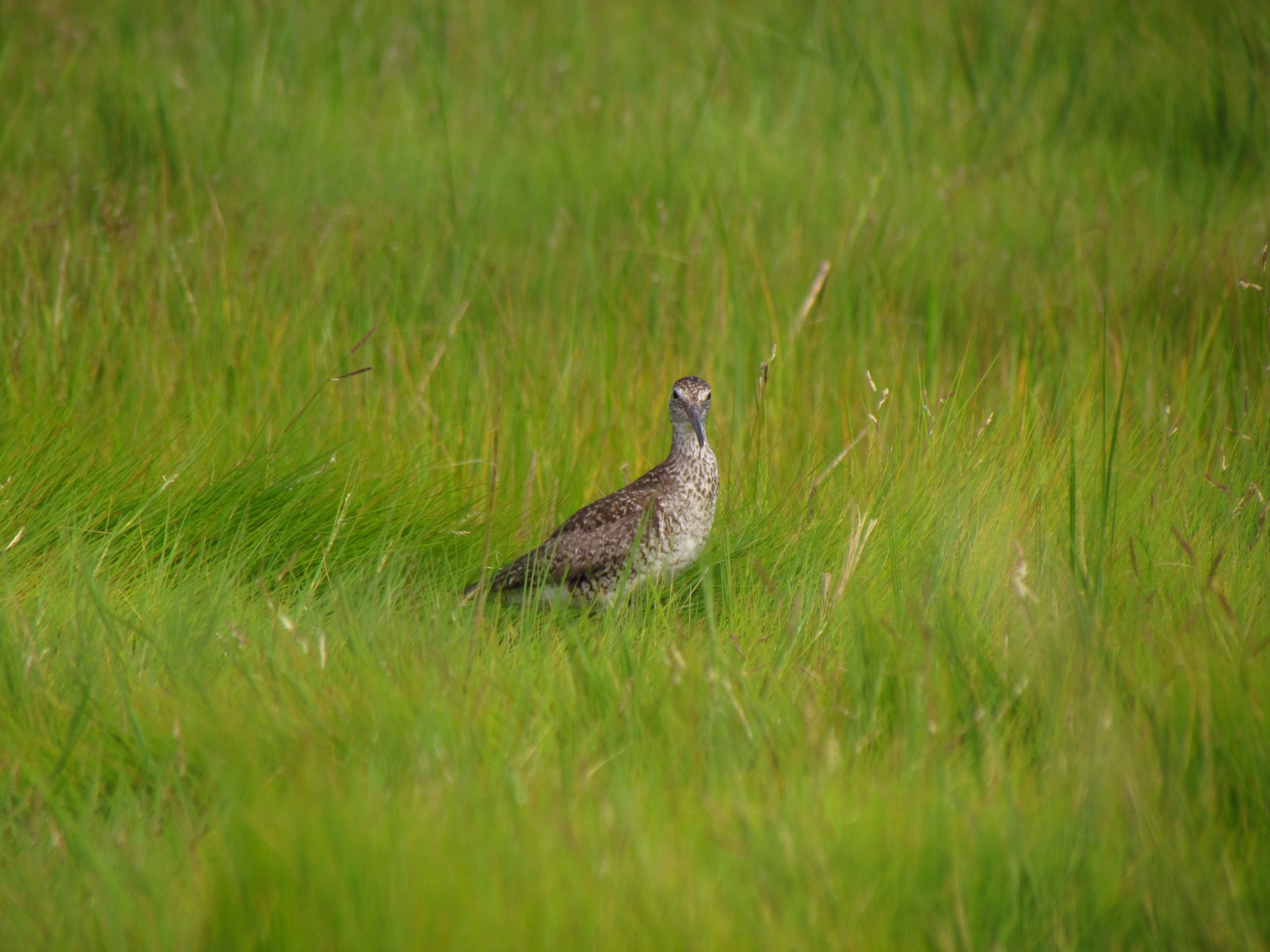
At this tide my eyes are well below the top of the spartina marsh, but the exposed silt banks bring out the shore birds that feed on mud critters.  I pass a few rather sedate Willets and then when I get to the first bend at the railroad tracks I flush five Yellow-Legs.  This is a significant event as the Yellow-Legs disappear when the Willets arrive.  I don't know what the relationship (or bad relationship) is between them, but they don't seem to like being in the same area at the same time.

In the Big Bends, I spot a few more Yellow-Legs.  It has been several weeks since I've seen a Willet up here - there are usually just a few.  Either this area is undesirable for Willet nesting or the numbers of Willets hasn't required using the area, yet.  For good measure I flush a juvenile Night Heron from near the Rock Pile (actually an old tide control dam or man-made ford for crossing the river...or both).  It is probably a Black Crowned Night Heron, but I can't be sure.

Yellow-Legs
Not long after passing under the Stone Arch Bridge I flush two herons - an adult Black Crowned Night Heron and another juvenile.  These are also significant events...the Night Herons are moving farther away from their rookeries now that their young are flying.  I don't see them here earlier in the summer.

Juvenile Black Crowned Night Heron
I turn at the Duck Hole Farms as the water is running thin.  Just about then, a Great Blue Heron flies across the river right up to a Great Egret spreading its wings and letting out a long "skraaaawk" and startling the Egret.  I broke out laughing at Nature's version of a practical joke.  It took the Egret a short minute to compose itself. 

My bird observations on my return journey are pretty much a mirror image of my observations on the way up.

Wednesday, August 1, 2018

Skedaddle


While putting in I catch the sound of very distant thunder.  This is the low and long rumble that makes you pause and think about what it is that you are hearing, and you only hear it if you listening to the world around you.  As soon as I start moving it is imperceptible.   It is someone else's storm. It reminds of the sound that comes from a train freight yard, one that is a mile away when an engine connects to a long line of cars. It is an indistinct rumble that goes on for a long fraction of a minute as each car in turn bangs into the next.
I set out to check on the young Osprey, heading up the Neck River and then into Bailey Creek.  The storm clouds are to the west and look like they should sweep north and away from me.  Halfway into the Sneak I surprise five Willets.  One remains and scolds me for minutes.  I suspect it is the same Willet that followed me and S the other day.  It was an unusually determined bird. 

There is that determined Willet
When I look up from my camera I catch a flash of far off lightning in the corner of my eye.  It might have been a trick of the light, a sparkle of something, but then again it might have been lightning.  I turn around and head back.  There is no cover in the salt marsh - and I am the tallest object for hundreds of yards around me.  The clouds are no longer sweeping past but are slowly pushing over.  The deep rumble of distant thunder is exchanged for the distinct crackle of something much closer.  A sharp edged lightning bolt reaches down.  I count the seconds between the sight and the sound.  It's a couple miles off.  A light rain comes just as I reach the put-in. 

Monday, July 30, 2018

Industrial

I put in at a junky and unmaintained canoe launch near the bottom of the Quinnipiac River.  It has all of the charms of an inner city start, the broken concrete shoreline, the collapsed cement sidewalk, and the abandoned restaurant that stands nearby.

This is old industry water.  Fishing boats have set out from here until recently, a few still do.  It's working waterfront, or was working waterfront. There were factories and warehouses, the river was a conduit for sea going enterprise, it was also a conduit for sewage and industrial waste.  I suppose it is better than it once was but it doesn't take much imagination to see what was going on.

I head down river and pass under a truss framed swing bridge, then a more recent (although not too recent) draw bridge.  The shoreline is walled or rip rapped.  The rip rap is stone or brick salvaged from demo'd buildings or concrete salvaged from who knows what.  It protects the shore from erosion.  It also walls people off form the water.  No one likes stumbling over loosely dumped rip rap.

Dead coal power plant on Ball Island
I turn up the Mill River.  When I said old industry, I meant the start of American industry.  Connecticut was the industrial state before the advent of steam power.  Textiles and high quality metalworking were major industries.  Eli Whitney, inventor of the cotton gin, built a gun factory for producing muskets on this river. 

The river is full of large schools of bunker.  Near the shutdown coal power plant on Ball Island I paddle over a school that runs bank to bank and a 100 yards long.  When the fish startle there are enough of them to create a small wake.

Above Ball Island the river narrows.  I pass under several bridges before reaching the tide gates.  I could portage and continue another 2 miles or so, but it seems a logical point to turn around.

Saturday, July 28, 2018

Osprey Check - Day 4

I set out with S from the put-in where the Neck and East Rivers meet.  We head up the Neck, which will bring us close to several Osprey nests.  Although it is again a warm day, a thin layer of high clouds makes it more comfortable than yesterday.

There is more flying today than there was yesterday, but not much more.  It still seems that the young are short of confidence.  The adult Osprey are staying close to the juveniles.  In fact, they do stay closer at this time then when the young are completely incapable of flight such that both adults are within a 100 yards or so.
The only nest that is unoccupied is the nest just below the Bailey Creek/Neck River fork.  This nest has an advantage of having a dead snag tree just 15 yards away.  Leaving this nest may not be as daunting as it is for the Osprey that nested high on the power pole over the railroad tracks.   When we pass the nest area, one of the juveniles gets up and takes a few circles before setting down in a tree.

We head up into the Sneak, which brings out one extremely determined Willet that scolds and follows us for about 15 minutes.  I miss a turn and take us through the Long Cut, which dumps us higher up in Bailey Creek.  We drop back down and again take the Sneak through to the East River.

After a ten minute break in the shade under the railroad bridge, we continue down the East taking the long dead end West Cut across the spartina to the forest, which is again busy with several Osprey, seen and unseen.

The young Osprey are still getting used to their wings.  They are flying only occasionally and not for any length of time...a minute or so is about it before resting.  The adults are standing close watch on the juveniles and appear at times to be encouraging them to fly by demonstration and then perching short distances away from the nest.

Friday, July 27, 2018

Osprey Check - Day 3

I set out specifically to observe the fledgling Osprey going through their continued flight training.  I don't intend to be out too long as it is hot, humid and sunny.  But, the Osprey are just not flying.  An adult here and there is seen aloft, but for the most part neither the adults or juveniles are flying.  Everyone is perched, as I suppose I should be. 
Common Tern
I flush Willets once in awhile as I paddle up the Neck River, Bailey Creek, and through the Sneak back into the East River.  Once I am upriver of the Sneak, I see no more Willets. 

At each of the bridges I pause for 2 or 3 minutes.  I have a light wind at my back and coming to a halt under the bridge doubles up the shade and breeze.  As I leave the bridge I mentally set my sights on the next bridge or next patch of trees overhanging the river.
Foote Bridge
Just below the Duck Hole Farms a Green Heron pops up out of the cattails and flies in its screwy dinosaur like manner over to the forest where I lose sight of it.  Normally there are several adult Osprey up here in the forest section of the river, but today it is just two. 

Green Heron
I take five under Foote Bridge, enjoying the quiet as well as the shade.  At the first major bend, next to the cedar swamp, I flush another Green Heron.  From then on I just paddle.  Back down through the Sneak, into Bailey, into the Neck and back to where I started.  There is still very little action going on in the salt marsh. One has to remember that I am not in charge of this whole thing.

Thursday, July 26, 2018

More New Pilots

I put in by the sea, closer to the Osprey nests that I'm heading out to observe.  The first few nests are family scenes - adults and young together.  Sometimes the adults share the nest, sometimes they are perched very nearby.  The young stand high and mighty on the nests...no more hiding for them.
Just stretching the wings
But, up at the first nest below the Bailey Creek/Neck River fork, seven Osprey stand in the trees, none are in the nearest nest, which accounts for two adults and two young.  The others come from another nest not far away.  While passing, two of the young get up and take a short loop around the area.  Their flights last all of a minute.  The young are easy to identify when flying - they can't or don't stretch their wings to full span, the flying is choppy with a partially bent wing, the wing beats quicker than those of a mature bird.

5 Osprey
The next nest is near the fork in the rivers.  One young bird is on the nest and the sibling is off somewhere else.  But it too gets up and takes a short circuit around the area as I get near.  I can't help but imagine that they must be amazed by this newly discovered skill, something like the first time someone gave me the controls of a small airplane.
Salt Marsh Sparrow
I figure that somewhere over half of the young Osprey in this area have managed to fly as of today.

I head up through the Sneak flushing five Willets.  Some of them are still in the area, but mostly what I have noticed is that they are less testy than in the spring and early summer when they are either fighting with each other over nesting territory or defending the nests they have built. 

I continue on up river taking a loop around the small island in the Big Bends before returning.  I take one side trip up a long dead end cut that runs west off of the main river.  The forest where it dead ends seems to have a half dozen or more Osprey in it.  Some are seen, some are heard.  

Wednesday, July 25, 2018

The First Fliers

I put in up in the forest, upstream of the garden gate that the tiny Foote Bridge makes.  When I pass under it and into the the forest marsh, everything becomes greater, everything becomes better.

I started in the forest for two reasons - There is a strong south wind that will blow me back to the put in when I decide that I've gone far enough, and the equation for the day includes the possibility of thunderstorms...at least for the first mile I will have a place to find cover.  I don't mind rain, but I do mind lightning.

I flush a Green Heron near the stone arch bridge.  They will become more plentiful later in the summer.  Adult Osprey are around as well, but that is so normal it hardly is worth mentioning.
Willet calling out from the spartina grass

A shower convinces me to pause under the Post Road Bridge, but it is only for 5 minutes.

The tide is up so I head into the Sneak.  I flush 5 Willets right away.  Not only are they flushed, but at least one of them stays in my vicinity warning anything else in the marsh of my presence.  I spot more Willets as I continue...quit counting at about 20.  There are many more here than I spotted on my last trip (I saw only 5) however, there seem to be maybe only half of what I would've seen during the peak of nesting.  So, they haven't migrated yet, but rather seem to have dispersed now that they are not anchored to a nest... they depend on each other for intruder warnings while nesting.

The first fliers...temporarily dazed and confused
I find most of the Osprey young still nest bound.  The exception is the nest on the Neck River just downstream of where Bailey Creek comes in.  An adult stands watch over two young that have managed to fly about 15 yards from the nest to a nearby dead snag.  I don't know how long they've been there, but the two youths seem to be wondering about what to do next.  I bet they've been there for hour or more...just a hunch.  I pass by and paddle down to the last bend and then return.  Neither of the young ones has moved.  An adult flies over to the nest and leaves a large fish as a temptation.  I continue on as my distraction will just add to their procrastination.  They'll figure it out once they realize that they have to do it themselves.
Two that haven't left the nest, yet