Saturday, May 30, 2015

Bird Band Identification

 
I let a hundred thoughts go through my head and now that I'm  nearing the end of a half day trip, I cannot remember what they were.

The Sneak

Of more importance is the wrens have begun to set up housekeeping, the cattails finally tall enough for them to build their double fist size nests, weavings of long dry strands of marsh stuff. 

wren nest - center of photo
I spotted my first nest just as I entered the first widening of the river and just as a mature bald eagle took off and headed away down river.  But, it is especially on the return, with some heat to the day, that I notice the numbers of wrens.  It seems that I am being passed on from wren to wren as I paddle, as the robotic chirp of one fades behind me a new one begins calling ahead.

Bird Identification - I had some trouble figuring this one out, until I noticed something on the right leg.

Bird band!

 Last summer, I talked with a University team that was catching and counting birds on the marsh.  This is possibly one of the seaside sparrows they were particularly interested in.  This bird requires salt marsh habitat for its survival.


Thursday, May 28, 2015

The Selden Channel

I cut straight across the river from the ferry landing to Whalebone Creek, but finding that I had the big river all to myself I delayed that side trip and followed the east shore down river into a mild and humid headwind that carried more weight than science would say exists.


About half of the way down the Selden Island it occurred to me that I had never paddled this shoreline on my more leisurely outward bound leg.  I'd only been here late in trips when I was tired and the horses were pointed towards the barn.  The forested shore, rocky at times, cliffed at others and turning to sand and marsh border berm as I go, is far more beautiful than I remember.

I turned the bottom of the island, going well wide out into the river to avoid the extensive sandbar that forms on the downstream of such landforms.  Entering the channel, I enter osprey land.  There are four nests that I know of - there were three when I first came here and I watched the fourth being built.  They are doing well.  They are all accounted for.
Selden Attack Swan
The channel is peaceful, sheltered from any wind and blanketed in the humid and moist swamp air, as it should be.  There is nothing remarkable except for the stillness and the sneaking around one of the Selden attack swans, and the pileated woodpecker that lets me observe for a full five minutes from thirty feet away.
pileated woodpecker
 

I do finally make the sidetrip into Whalebone Creek and it too is quiet and soft.  There are a few geese with goslings, a few songbirds, and a pair of ospreys.  It is a far cry from March when the creek was well packed with ducks stopping off on their way north.

The cattail spears are almost to the bottom of last season's "cattails", which are finally breaking up and spreading seed with the wind.

Tuesday, May 26, 2015

Ruddy Turnstones


Those that strive to maintain control often find themselves to be the least in control.  The rigid grip on power leads only to rigidity and the inability to adapt.  This is perhaps the primary lesson that wildness can teach us, that what we know is far less than what we don't know, that there are things happening that we not only cannot control, but that we just don't understand.  Do the best that you can and roll with the punches.

I start from the Foote Bridge on a falling tide.  There is little current as today is a day of mild tides, the highs not very high and the lows not particularly low.  The water is dusted with pollen and seed from spring blooms.  Wading ankle deep to launch the canoe, I find the water cool, but not a seasonal cool, more the cool of early morning water.

As I near the big bend I spot a bird low in the water and too far off to identify.  As I near, it swims toward shore - a mother bird action, and I lose it in the undulations of the bank.  It reappears up in the spartina, a red brown duck with at least two ducklings in tow.  Every few seconds her head pops up tall and proud, just long enough to locate me, and then it drops from sight.  She is concerned about me, until a crow comes into play.  She chases it once, and then two red wing blackbirds come in and harass the crow until it goes away.
oyster catcher
 There are, today, about half as many birds as I would've seen last week.  This is probably due to about half of the birds in the marsh tending a nest.  I see quite a few willets, although about half of what I would expect, a pair of oyster catchers, which I did not expect at all, and no osprey until I get close to the sea and their nests.
ruddy turnstone
At the last bit of land before the mouth of the river I find a nice flock of ruddy turnstones feeding on the sand at the water's edge.  It has a very busy color pattern.
When I turn back up the river, I find that the weather has changed.  The warmth of the day has come on and the morning cool is replaced by the humid soft steam of day climbing into the 80's.

I wade much of the last half mile, the not particularly low tide having not particularly enough water to float a canoe. It feels good.
Sunday, May 24, 2015

The End of Sane Season

It's the end of the sane season - October and into May when most people think that it is too inclement to be on the water.  Memorial Day weekend is the traditional first day of the Insanity Season, a day when everyone goes to the water, whether they should or not.  For me, it is a day to lie low.


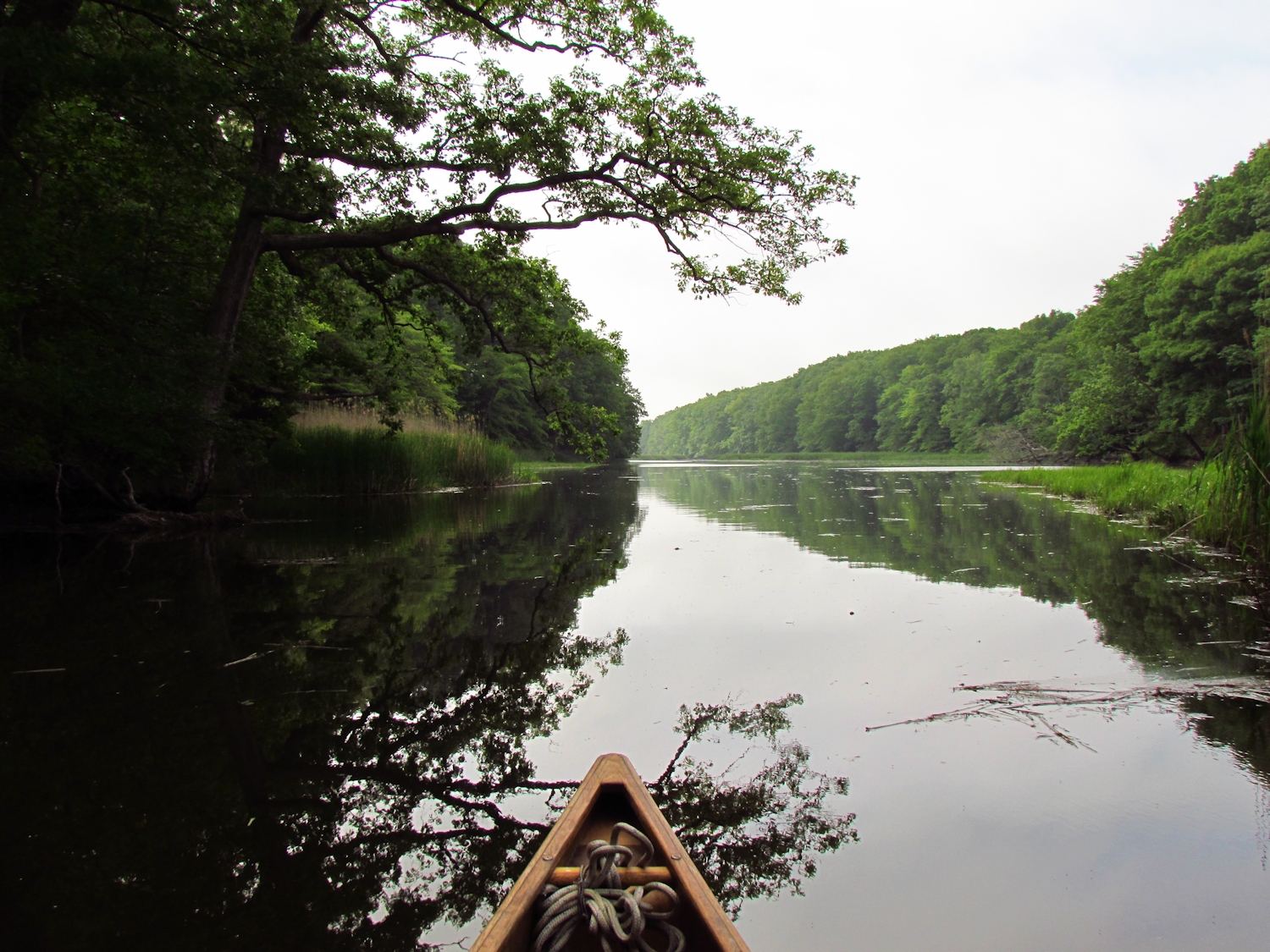
I take S for her first trip to Messerschmidt Pond.  The pond is surrounded by trees and well enough back from the coastline, which is windy today.  It is also limited to paddles and small electric motors.  I expect a fair number of boats, but we find just a few.  We steer clear of the others, passing behind islands and rounding points... everyone has the pond to themselves.

The trees are well leafed out now and the birds are difficult to spot.  But, the pond is mostly quiet and the singing of songbirds reaches out to us the entire time. It is one of the most restful days that we have had on the water.

Thursday, May 21, 2015

Getting Stuff Done

Garbage eroded.  Always worth a look.
The 4 inch pvc pipe sticking out of the mud is actually the body of a ornate ceramic creamer.  A heavy clay piece is a bicycle pedal once the mud is rinsed off.  I gather several more objects.
eroded garbage
I set out from the Gifford Pinchot Sycamore, a sycamore mind you, that has a DBH..diameter at breast height of about 8 feet.  A worthy dedication to the first leader of the National Forest Service, which for all of its limitations, deserves enormous credit for preventing the wholesale land rape that would have occurred without it in the western United States.  He came from Yale, in a state that has no National Forests.  Today, 60% of Connecticut is forest.  Enough.

The Farmington River is fairly wide, a middling sort of width, and it has long gradual bends so that one can see a quarter or a half mile ahead.  There's no sharp turns and there's no debris to dodge. That middling width keeps the interesting things that happen at the edges close enough to the canoe for fine observation.  The river is always a bit short on wildlife, a result of too many towns, farms and golf courses  hidden behind the trees that line the bank.  But, the floodplain keeps houses and other buildings out of sight for the most part.  I spot a couple deer, a pair of Canada geese tending 5 goslings, a mother mallard guarding 9 or 10 ducklings...mostly it is song birds and a hawk or two. 
Today, it is the perfect river for me.  It requires no concentration to navigate and there are few of the natural distractions that cause me to pause from my paddling.  Today, I just paddle and let my mind run.  There is no point that I must reach before turning back, there is nothing that I need to investigate.  I work out the text, as much as I ever work out the text, for a presentation.  I think about far off places and far off ideas.  I paddle a lot without pause.  I accomplish much.

I go upriver 3 hours and downriver 1-1/2, starting and ending at the big sycamore.

Sunday, May 17, 2015

The Good Egg

"We should start early if you can.  If we're the first into the swamp, we'll see more wildlife and we won't probably see anyone until we head back out."

We're on the water, setting out into the Great Swamp by half past eight.  Not an especially early start, but maybe early enough.  It's clear, still in the morning cool, and it's quiet.  I met H through an art auction.  His bid won him one of my paddles and a canoe trip.  The paddle has a map of the Great Swamp on it, so a trip to the Great Swamp made perfect sense.  I clean up his paddling technique as we start, but he pretty much knows enough already. 

We meet a guy coming out when we get almost a mile in.  He has turned around at the first beaver dam, which is good for us because it is just a few hundred yards ahead and there won't be anyone above that.


We talk about this and that, the same kind of stuff that pours from peoples mouths when they meet over a canoe.  It's all good. It is fortunate for me that a good guy won the bid.

The water is down a bit from my early spring trips.  It takes a small amount of effort to get over beaver dams, nothing too tough until we get to a big forked tree that has come down at the end of the forest section.  I ask H if he wants to go on and he does.  Good egg.  We clamber out, slide the canoe between the two trunks and into the water on the opposite side, and then the two of us follow.  It was a grunt, but it was a brief grunt.

We paddle the full section up to Patterson where we meet, by chance, R, who is a key dude with the volunteer group that helps to protect the swamp...and we have a good chat. 

Then we head back out, the day warming but the wind picking up enough to keep it cool.  The frogs sing a bit more.  We add an osprey sighting to the mink, muskrat and dozen or so great blue herons and dozens of red wing blackbirds and the turtles and the pair of flickers and the two white tailed deer and the mallards and Canada geese that didn't get counted and some others that I forgot.

It was a fine day...  13 miles.

Friday, May 15, 2015

Things You're Not Supposed to See


Some people say that I am eagle eyed, but there is not much truth in that.  My eyes are no better than most and worse than some.  But, I am tuned in to my environment, and "tune" is probably as good a word as any because it's the constant tuning and adjustments that lets me pick out birds and animals before others.  When I've been shore bound for awhile or when the seasons change, I miss more things.

I spotted a cormorant out on the big water, well off, a low in the water black bird who holds its head too proud, always nose up.  Near Casa Rosa, also a long ways off, is a common loon.  A low in the water dark bird that holds its head level, nature having spanked it for strutting its beauty by moving its feet so far back that it cannot walk on dry land.  A tough lesson.
the Oyster River
 I woke up today thinking about the things I see from the canoe...especially the shape changers.  These are the herons, otters, seals and shorebirds that you spot from 200 or 300 yards out.  And you close in ten more yards, and ten more yards and ten more yards and somewhere along the approach they turn into a bent upturned tree root or stump or drift log.  It might be natures sense of humor, or they might be someone else's spirit animals waiting for that person to become accessible.  Maybe they are spirit animals for people that are lost.
1st year red-throated loon?
I get into the Oyster River and all is normal until I get past the deadfall tree and I spot what seems to be a very small loon.  It is also an unusually calm bird and lets me approach fairly close.  It dives and swims right beside the boat where I get a superb view of its frog kick swimming.  It seems to be a juvinile red throated loon.  I just wouldn't expect to see one here.
1st year red-throated loon?