Thursday, May 14, 2015

Tipping Point

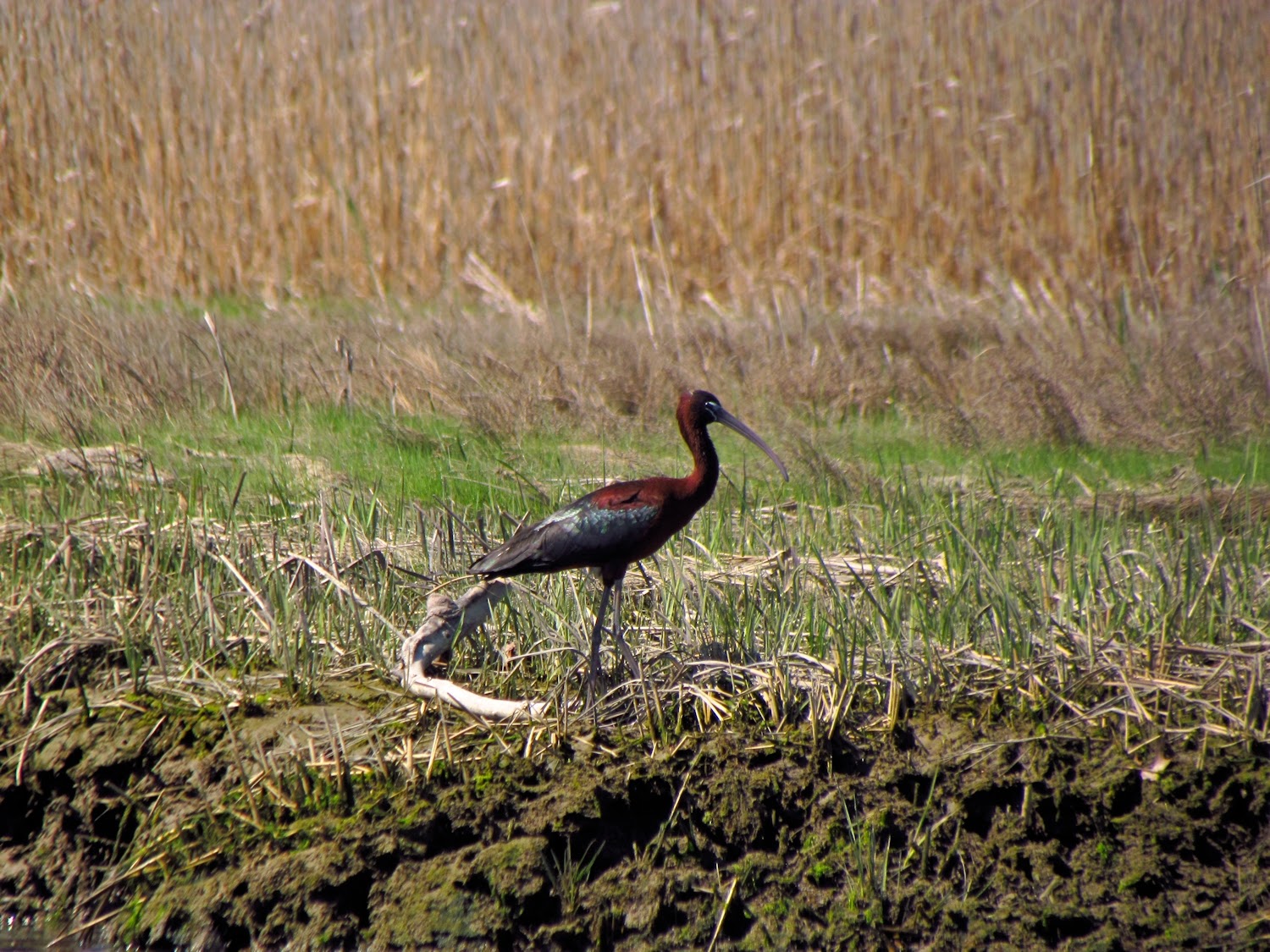
I head upriver into a stiff wind sometime around the peak of the tide.  Mentioning ospreys seems almost redundant as there are nearly thirty osprey nests in plain view.  They are flying, they are perched on logs, they are tending their nests.  I find six or eight glossy ibises along the way and a good congregation of snowy egrets, great egrets and ibises in the wind shadow of a forested rock island near the mouth of the Duck River.  Of course, I see quite a few willets, sandpipers and dunlin and a few small terns.


I head up the Duck, not remembering too mush about it not having been up there in a year or so.  After less than a mile, I get to the culvert under the road that blocks further passage.  Now, I remember why I haven't been here recently.
great egret

I head back down on the beginnings of the ebb, pass the put-in and head up the Black Hall River.  Even now, the edges of the extensive mud flats and shallows is becoming apparent and I hurry into the river's main channel.  I was here last when the ice was breaking up.  But, it's a good river, an hour or more up to where it becomes dense cattail marsh, and there's always a change to the scene at each bend.
glossy ibis

I'm canoeing enough at this point that I have to encourage myself to go out.  But, I know well enough that this is the point where I get a deeper payback.  This is the tipping point where I begin to not be a visitor, where any remaining novelty is gone.  It is the point where I stop finding things in nature and nature starts finding things in me.
Black Hall River
I paddle 3 more hours.  I don't write.  I see birds but count none.  They do the counting.

Where: Mouth of the Connecticut River, Duck River and Black Hall River

Monday, May 11, 2015

Courting

It's an old place today, a low tide salt marsh, exposed decay in the air and all is blurred by the remains of a night fog.  It is still.  It is paddling a photograph.

I find a bottle with a message in it at the 4th bend, stranded at the edge of the spartina, left near the high tide mark.  I suppose it was about time that something like this happened.  I collect it and will open it when I get home.

At first it is bird still, at least visually.  I can hear them back in the trees, but the singers remain unseen.  I finally scare up a cormorant and four snowy egrets as I round the last bend before the marsh opens up broad and big sky.  Then, a pair of Canada geese beginning honking, annoyed by my presence.  The sun burns through the haze and I return to the present.  A willet trots away from me following the water's edge.

I let the canoe nose into the mud while watching a nearby willet.  Then, it begins a courting dance with a second willet that I had not noticed.  It approaches the female slowly from behind, calling and flapping its wings before finally hopping on top of her back and continuing with the flapping wing display.  It takes one and a half minutes.

This morning, I almost convinced myself that I had something more important to do other than canoeing.

I continue down river and out of the Menunketesuck, through the huge Westbrook boat parking lot and up the Indian River.  I haven't been here before but it is good enough to return to.  There is a possible portage between the Menunketesuck and the Indian that would eliminate the boat parking lot section.  The two rivers almost join at their last bends.
Little blue heron, Indian River
On the return up the Mununketesuck I come across five glossy ibises feeding in the exposed mud flats at the edge of the river.

Sunday, May 10, 2015

Rerun

S wanted to do some bird watching today so I took her back to Bailey Creek, where I had been yesterday.  I let her sleep long in the morning, so our day started hours later than normal for me.  It was already in the 70's with a water haze in the air and a wind from the southwest that was moderately strong.
We set out up the Neck with the wind at our back and several osprey in the air all around us.  S practiced her bow steering strokes as we paddled through the meandering Neck and Bailey Creek, the wind and tide current creating a multidimensional problem of leading or lagging the steering so that the wind, tide and bend all add up to putting the canoe somewhere in the middle of the channel. 

Least sandpipers are commoon the whole way, dunlin hog the confluence of the East and Neck, turtles outnumber birds once we get into Bailey Creek, and the fiddler crabs up there outnumber everything. 

When the creek runs shallow we stop for a break and watch two willets hunting for fiddler crabs.  The wind dies down some while we sit, and then we head out.

Saturday, May 9, 2015

A Seashore Day

It is a seashore day - cloudy overcast with a heavy damp air and a chilling breeze.  It is also low tide, or an hour past it I suppose.  So, although my distances will be shortened by low water in the upper sections of the river, the muddy spartina banks will be exposed drawing the shorebirds in to feed where I can see them. 
cormorant
The top of the marsh above me, I will be paddling in a strata that was laid down a hundred years or more before.  I wonder if people think about how far back in time the bottom of their dock pilings are...
My osprey theory proves correct today, swiveling my head around I verify that there is at least one osprey in the air at anytime.  A heavily laden one lumbers across the river with a large porgy in its talons.  They all seem to be eating well today.
Least Sandpiper
Instead of the East, I have headed up the Neck River.  Where I take the fork up into Bailey Creek, there is a long section of what is probably corduroy track.  It looks like someone, about 2-1/2 feet of spartina accumulation ago laid down a section of saplings and small logs to make a crude roadway.  Spartina was known as salt hay and was mowed for livestock food.  The entrance to the creek is through a break in an old dike...access to the corduroy road from dry land.
corduroy road
I'd only been up the creek at high tide but there is plenty of water until the last 200 yards.  It is good bird watching - egrets, cormorants, dunlin, willets, yellow legs, sandpipers, geese, and one glossy ibis that is carrying nesting material in its long curved bill...solving my question.  I spot the ibises in April and early May, then they disappear.  But they don't disappear too far away, rather they have built nests nearby and don't venture too far until their young can fly.
might be a migrating short billed dowitcher


Thursday, May 7, 2015

Truth Serum

Dammit.  I hit a rock paddling the fast section just before the Leesville Dam and put an eight inch split in the paddle.  Such it is with real wood paddles.

It took forever to get here.  I planned to explore a section of the Quinnipiac River that I'd not been on, but never found a good spot to put in.  The best was all too close to the top of a low head dam, a little too dangerous to be messing with.  So, I took a long twisting route across country to familiar haunts, frustrated by the long drive just about as much as by a community that has cut itself off from its own river... the legacy of using rivers as sewers I suppose.


I end up at the Salmon River, putting in at its confluence with the Connecticut.  It is summer warm already and nearly dead calm.  Even the birds have gone quiet today as if they did their feeding earlier in the day to avoid the heat.

Low tide keeps me in the fairly narrow deeper channels...which sometimes put no more than 8 inches of water under the canoe.  I enter the mouth of the Moodus, but can't go to far, although it gives me a chance to scan the bottom for interesting objects.  Sometimes I find some older broken pottery in here.  This was a mill river with several yarn mills and the expected habitations of mill workers.

cormorants
Stopped by the low water, I return and head up the Salmon River proper.  I just burn some paddling off with little wildlife to watch and only a couple of people at the summer cabins on the side of the river.

And, I turn back from just below the Leesville Dam after cracking my paddle.  The wind comes up and I will be paddling into it.

yellow legs and bird butt
"If you bought this house you'd be home already," comes from riverside.  I stop and greet a guy who, it turns out, is prepping his parents cabin for sale.  The canoe truth serum kicks in.  It is a funny thing about canoes.  People will open up and have the nicest conversations with you, if you have a canoe.  It is almost like they are next door neighbors.  We talk about work, about our wives, about their work, about birds, art, his son, the house, Johnsonville, the closed down and removed nuclear power plant, and the resort the once sat on the opposite bank.  We talk for over a half hour, although I didn't check, it might have been longer.  And then I continue and he goes back to work.  It occurs to me that canoeing could quite possibly be one of the most positive diplomatic activities that the world leaders could take part in...  as long as those assholes aren't in my canoe.

Wednesday, May 6, 2015

New Waters and a New Bird

I started out to explore a tidal river that I haven't seen before, but the tide thought otherwise and I found less water than will float a canoe.  I'll need mid-tide and will have to come back later.  But, not far off was a pond that I had passed on numerous occasions that deserved a visit.
Messerschmidt Pond
I set out, greeting a fisherman that was leaving without luck, at least as far as catching fish went, because I imagine that the morning was beneficial even without fish.  It is not a large pond, surely less than a mile from end to end, but it has an undulating shoreline with several coves and a few islands.  Follow the edges and it makes for a long enough paddle.
Right away I notice a tang in the air.  It is an earthy sharp aroma, a desirable oak scent that would be good on the edge of a cheese or meat.  It might be something in bloom, but it smells more like leaf dust being kicked up by raindrops from a light sprinkle as the drops strike the forest floor. 
goose nest...and defensive posture

I follow the edges, a forested shoreline with the right amount of shrub and brush, good habitat for all.  Once around the points at out of line of sight from the road it goes quiet and birdsong and rain patter make the soundtrack. 

There is some beaver sign - scent mounds as well as cuts... not a lot, but some.  I don't spot any lodges, so they're probably bank beaver.  I find a goose nest on one of the islands in the center of the pond.  And a yellow bird half hearted plays hide and seek on another island.
Phrothonotary Warbler...apparently a rare visitor to NE


but pretty obvious and easy to ID in the bird book


Tuesday, May 5, 2015

Don't Step in That


I almost fell into the trap, I had to remind myself to return to the track.  I went out to the marsh, two marshes to be exact, although I passed at putting in at the first one.  Today, and probably for another week or so, the marsh is what most people would call unsightly.  And, that is the trap that I stepped into, because the marsh is, of course, exactly as it should be at this time of the year.  The grasses have all collapsed and are covered in a thin layer of tidal silt... it's grubby... worn out.  If it wasn't a marsh, one might think that it was a post-harvest farm field with little left to show for the bounty other than stubble and shreds of plants.  I had to tell myself that this is what it is supposed to be.  Until I turned the corner, the one where a ridge of land sticks into the marsh, where archaeologists found the remains of a Native American fishing site.  I turned the corner and found some fifty glossy ibises stabbing their long curved bills into the spartina marsh searching for food.  I needed no more of a reminder.
glossy ibis
I head up towards the top of Nell's Island noticing far more shorebirds than anyone would expect, far more than anyone on land can see.  Their camouflage is ideal for conditions.  I suppose that once the grasses grow and brush leafs out they will have plenty of cover no matter what color their feathers are. but right now the greys, tans and patterns of their feathers make them blend in with the sparse remains of last year's growth.  I miss a good many photographs because I don't spot them until I flush them.
mute swan nest
Of course, the egrets stand out and spotting a well constructed swan's nest is no challenge.
I spot an orange man in an orange kayak behind me and coming towards me.  I turn into one of the circuitous and often dead end channels in hopes of discouraging a meeting, should that be his intention.  I know from all too many encounters with "people in boats" that if we talk, the talk will likely be about boats, performance and gear...seriously boring and distracting stuff to bother with when surrounded by willets, yellow legs, ibises, brandts, Canada geese, osprey and egrets.  I hope his tour is as good as mine. 
brandts
As I get closer to the sea the bird life changes.  Farther back, the ibises were the most numerous of the larger visible birds, but near the sea brandts take over in force.  At one time I flush about a 150 at once, and they are scattered throughout the lower half of the marsh.
oyster catcher
I finish the trip with a spotting of four yellow crowned night herons a couple hundred yards before the put-in.  They fly up into nearby trees and wait for me to leave.
yellow-crowned night heron
Where:  Wheeler Marsh at the mouth of the Housatonic River